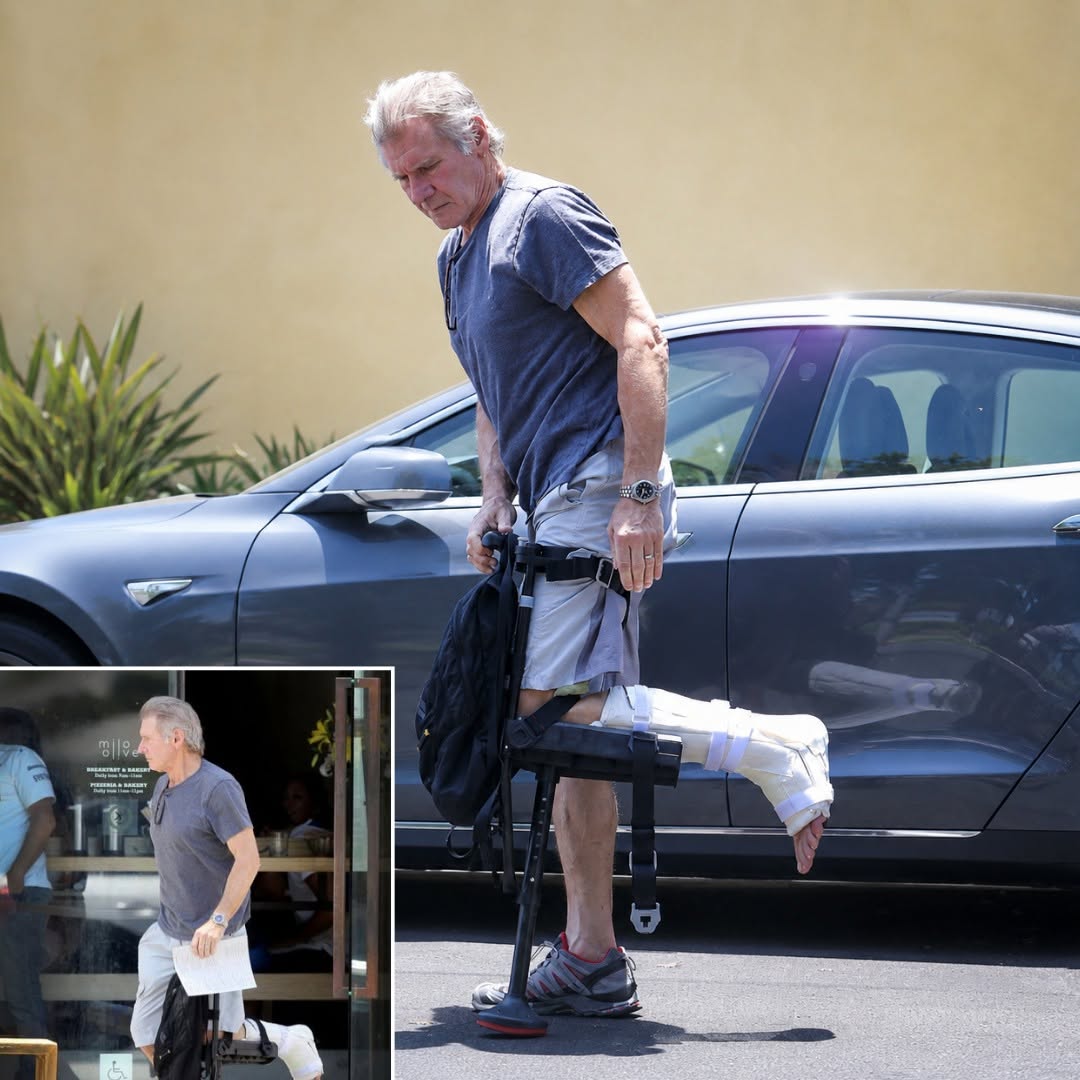
For nearly half a century, Harrison Ford has represented a particular kind of American movie hero.
He was never the most polished man in the room. His characters often looked tired, irritated, or thoroughly unimpressed by the danger surrounding them. Yet beneath that familiar expression was a quiet determination that made audiences believe he would somehow find a way forward.
That is what makes these candid photographs so appealing.
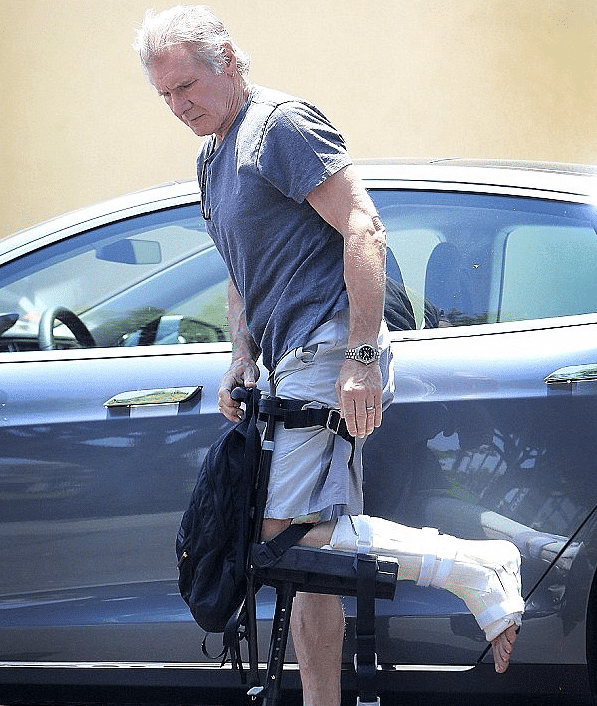
Instead of showing Ford inside a spaceship, an ancient temple, or the White House, they capture him during an ordinary off-duty moment. Dressed comfortably and wearing a full silver beard, he looked less like a carefully styled movie star and more like a longtime neighbor heading out for dinner.
A Quiet Evening Far From the Red Carpet
Ford was photographed arriving at the historic Sportsmen’s Lodge in the San Fernando Valley for a casual meal with a companion.
He wore a pale blue sweater over a button-down shirt, gray trousers, and brown shoes. His thick beard immediately reminded some longtime moviegoers of Dr. Richard Kimble, the physician he portrayed in the 1993 thriller The Fugitive.
There was nothing especially dramatic about the outing.
No premiere was taking place. There were no formal interviews, studio lights, or crowds waiting behind barricades. Ford appeared to be doing what millions of Americans do at the end of an ordinary week—meeting someone for dinner and enjoying a few quiet hours away from work.
That simplicity gives the pictures their warmth.
Famous actors are usually photographed when everything has been prepared. Their clothes have been selected, the lighting has been tested, and every step along the carpet has been planned.
An off-duty photograph offers something different.
Video: Sabrina (1995) – Aww! Harrison Ford’s Romantic Reunion Scene
It reminds audiences that behind the legendary characters is a real person who still experiences traffic, dinner plans, changing weather, and the natural passage of time.
The Carpenter Who Became Han Solo
Harrison Ford’s journey to stardom did not follow the traditional Hollywood script.
Born in Chicago in 1942, he moved to California and began accepting small acting jobs. When those early opportunities failed to provide a dependable living, he supported his family by working as a carpenter.
That practical trade eventually placed him near filmmakers and casting conversations that would transform his future.
Ford had already appeared in George Lucas’s American Graffiti before he was selected to play Han Solo in the original Star Wars, released in 1977. The role made him internationally famous and gave popular culture one of its most enduring characters.
For Americans who saw the movie during its original theatrical run, the experience remains difficult to recreate.
There were no online trailers watched repeatedly for months. Tickets were purchased at the theater, audiences waited beneath glowing marquees, and word of mouth traveled through workplaces, schools, and neighborhood conversations.
Han Solo was different from the traditional heroes audiences expected.
He was skeptical, impatient, and motivated partly by money. He did not immediately believe in noble causes or mystical powers. Yet when his friends needed him, he returned.
Video: Harrison Ford Demos His Star Wars Injury Using a Han Solo Doll
Ford’s dry delivery and understated confidence made the character feel both larger than life and strangely familiar.
Indiana Jones and the Great Adventure Era
Only a few years later, Ford introduced audiences to another character who would become inseparable from American movie history.
Raiders of the Lost Ark arrived in 1981, with Ford playing archaeologist and adventurer Indiana Jones. The film combined the spirit of old movie serials with modern action, humor, romance, and unforgettable music.
Indiana Jones was brave, but he was never invincible.
He became exhausted. He made mistakes. He disliked snakes. He survived dangerous situations through experience, instinct, and occasional good fortune rather than superhuman strength.
That vulnerability helped make him beloved.
Many older viewers remember watching the original Indiana Jones films with their children and later introducing the same adventures to grandchildren. The hat, leather jacket, and bullwhip became recognizable even to people who had never watched an entire movie.
Ford returned to the character across more than four decades, most recently in Indiana Jones and the Dial of Destiny in 2023.
Few actors have been given the opportunity to grow older alongside a fictional hero for so many years.
More Than Two Famous Franchises
Han Solo and Indiana Jones could have overshadowed almost any career.
Ford, however, continued choosing roles that revealed a wider range.
In Ridley Scott’s Blade Runner, he played Rick Deckard, a weary investigator moving through a haunting vision of the future. In Witness, he portrayed a Philadelphia police officer protecting a young Amish boy, earning his only Academy Award nomination for Best Actor.
He also appeared in Working Girl, Patriot Games, Clear and Present Danger, Air Force One, and What Lies Beneath.
These films allowed Ford to become a different kind of leading man.
His characters were often professionals suddenly placed under extraordinary pressure: a police officer separated from his familiar world, a president defending an aircraft, or an innocent man forced to prove that he did not commit a terrible crime.
Ford rarely played these men as perfect.
They became convincing because they seemed frightened, frustrated, injured, and uncertain while continuing to act.
The Beard That Brought Back The Fugitive
The silver beard visible in the candid photographs prompted immediate memories of The Fugitive.
In the 1993 film, Ford portrayed Dr. Richard Kimble, a respected surgeon wrongly convicted of killing his wife. After escaping custody, Kimble searches for the real perpetrator while Deputy U.S. Marshal Samuel Gerard, played by Tommy Lee Jones, leads the pursuit.
The movie became one of the most admired thrillers of the decade.
Unlike many action films, it relied as much on intelligence and character as explosions. Kimble did not become an unstoppable fighter. He survived because he observed details, understood medicine, and refused to stop searching for the truth.
For audiences who remember the film’s train wreck, hospital sequences, and tense confrontation beneath Chicago, Ford’s bearded appearance in 2016 created an immediate visual connection.
Yet the beard did not necessarily signal a secret return to the character.
Sometimes an actor’s appearance is simply his appearance.
The public connection demonstrates how strongly certain roles remain in collective memory. One haircut, jacket, or expression can instantly return viewers to a theater they visited decades earlier.
A Serious Accident Behind the Movie Magic
The quiet dinner outing also came after Ford had recovered from a major injury suffered while filming Star Wars: The Force Awakens.
In June 2014, a heavy hydraulic door on the Millennium Falcon set struck him at Pinewood Studios in England, pinning him down and breaking his leg. He required surgery and rehabilitation before returning to the production.
The production company later admitted breaches of workplace health and safety responsibilities and was fined £1.6 million in 2016. Investigators said the force of the door was comparable to the weight of a small car and that the accident could have been fatal.
The incident offered a sobering reminder of what exists behind cinematic fantasy.
Audiences see spaceships, ancient ruins, and daring escapes. Actors and crews see machinery, construction, cables, heavy equipment, and long working days.
Ford returned to complete the film, once again bringing Han Solo to the screen nearly four decades after the original Star Wars.
His recovery reflected the same stubborn resilience audiences had long associated with his characters.
A Career Honored by American Film
By the time these photographs were taken, Ford’s place in cinema history had long been secure.
The American Film Institute presented him with its Life Achievement Award in 2000. AFI describes the honor as its highest recognition for a career that has contributed significantly to American culture.
The award recognized more than box-office success.
Ford’s characters became part of the language of popular culture. Their clothes, expressions, dialogue, and adventures shaped how generations imagined heroes.
Yet Ford’s appeal has always depended partly on his resistance to the traditional image of stardom.
He often appears uncomfortable with elaborate praise. His interviews are known for dry humor, brief responses, and an unwillingness to turn every professional experience into a sentimental legend.
That personality has helped preserve his authenticity.
He never seemed to be asking audiences to admire him.
He simply did the work.
The Meaning of an Ordinary Photograph
The photographs outside the restaurant contain no major revelation.
They do not document an engagement, award, or new film announcement.
They show Harrison Ford walking into dinner with a friend.
Yet ordinary images sometimes become valuable because they stand apart from the grand stories surrounding a famous life.
Movies preserve Ford escaping Imperial forces, recovering ancient treasures, chasing fugitives, and protecting presidents. These candid photographs preserve something quieter: a man choosing a sweater, meeting someone for dinner, and moving through an ordinary California evening.
For longtime fans, that contrast may feel reassuring.
The heroes of their youth grew older because they did too.
Theaters changed. Ticket prices rose. Video stores disappeared, and entire film libraries moved onto small screens. Children became adults, and familiar movies became family traditions.
Through all those changes, Harrison Ford remained recognizable.
Not because he stayed young, but because the qualities audiences valued—determination, humor, independence, and an unmistakable refusal to make a fuss—continued to be visible.
The off-duty man in these photographs may not be carrying a blaster or wearing a weathered fedora.
Still, one look is enough to remember every adventure.