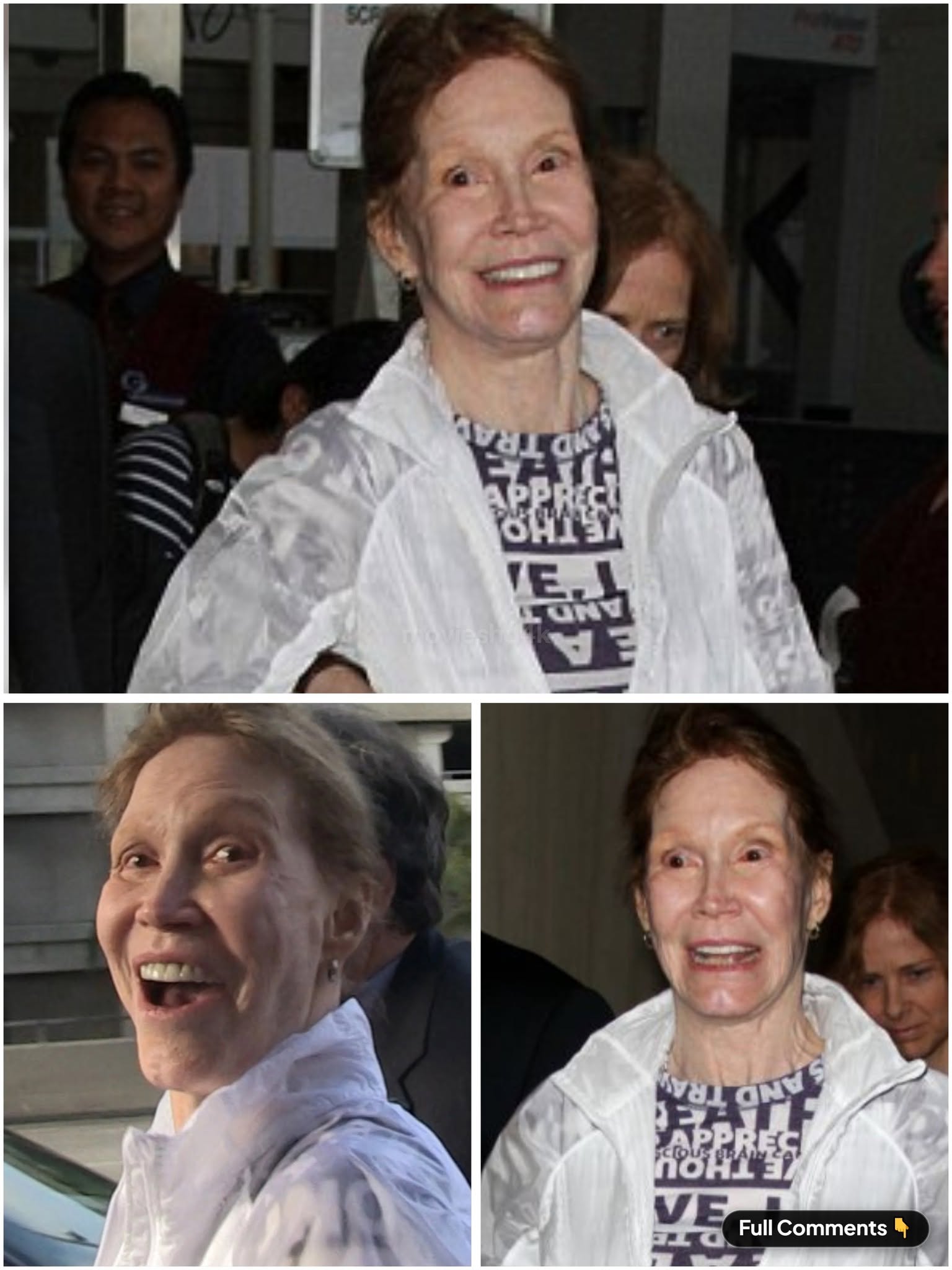
For generations of television viewers, Mary Tyler Moore remains one of the most instantly recognizable faces in American entertainment. A candid airport photograph circulating alongside this story shows the beloved actress far removed from the bright studio sets, polished costumes, and confident characters that made her a television icon. Dressed casually and moving through Los Angeles International Airport, Moore appears in a quiet, everyday moment that contrasts sharply with the glamorous image many fans remember.
The photograph is archival rather than recent. Moore died in 2017 at the age of 80, but images from her later public appearances continue to draw attention because they reveal a more private side of a performer whose career stretched across television, film, theater, and production.

A quiet airport moment with a television legend
In the candid images, Moore is seen in a much more informal setting than the red carpets and award ceremonies that defined many of her public appearances. The source describes her moving through LAX while being assisted through the busy terminal. At the time, she had already undergone surgery to remove a benign meningioma, a tumor arising from the tissue surrounding the brain.
Her representatives announced that procedure in 2011, when Moore was 74. The tumor had reportedly been monitored for several years before doctors recommended surgery. The operation became one of several health challenges Moore faced later in life, but it did not diminish the extraordinary body of work she had built over decades.
For fans, the airport photographs are poignant because they show a person who had spent most of her adult life in front of cameras simply navigating an ordinary day. There is no sitcom punchline or carefully composed publicity portrait—just a familiar face captured outside the spotlight.

Laura Petrie made her a household name
Moore’s place in television history was secured in the 1960s when she was cast as Laura Petrie on The Dick Van Dyke Show. Playing opposite Dick Van Dyke, she brought wit, elegance, warmth, and sharp comic timing to a role that could easily have been written as a conventional sitcom wife.
Instead, Laura Petrie became one of the most memorable women on television. Moore’s performance felt modern and energetic, and her style became almost as famous as her comedy. Her capri pants in particular became a signature look at a time when women on television were still often expected to appear in dresses and skirts.
What mattered most, however, was the chemistry between Moore and Van Dyke. Their scenes together gave the show an easy rhythm that made Rob and Laura Petrie feel like a believable married couple rather than simply characters delivering jokes. Moore’s work on the series established her as a major star and earned her multiple Emmy Awards.

The Mary Tyler Moore Show changed television
Her next defining role took her even further. In 1970, The Mary Tyler Moore Show premiered with Moore playing Mary Richards, a single woman in her thirties who moves to Minneapolis and builds a career in a television newsroom.
The character represented a major shift in mainstream American television. Mary Richards was not defined by a husband, children, or a search for marriage. She had a career, a home of her own, close friendships, ambitions, disappointments, and a life that did not need to fit the traditional sitcom mold.
The show became both a comedy landmark and a cultural touchstone. Its ensemble cast included Ed Asner, Valerie Harper, Cloris Leachman, Ted Knight, Gavin MacLeod, and Betty White, among others. The series was praised for combining smart comedy with stories about work, friendship, gender expectations, and adult independence.
Moore’s famous hat toss in the opening credits became one of the enduring images of 1970s television, but the show’s impact went far deeper. Mary Richards helped expand the kinds of lives female characters could lead on prime-time television.

Her influence extended behind the camera
Moore was not only the star of a groundbreaking series. She also became a major force in television production through MTM Enterprises, the company she co-founded with then-husband Grant Tinker.
MTM Enterprises went on to produce a remarkable collection of acclaimed television shows, including Rhoda, The Bob Newhart Show, Hill Street Blues, and St. Elsewhere. The company developed a reputation for sophisticated writing, strong ensemble casts, and a willingness to give creators room to experiment with television formats.
That production legacy is sometimes overshadowed by Moore’s performances, but it is an important part of her influence. She helped shape not only what viewers saw when she was on screen, but also the kind of television that followed.
She proved she could do far more than comedy
Although Moore was loved for sitcoms, her career was not limited to comedy. Her dramatic work in Robert Redford’s 1980 film Ordinary People surprised viewers who knew her primarily as the warm and funny Mary Richards.
Playing Beth Jarrett, an emotionally distant mother in a family struggling after tragedy, Moore delivered a restrained and unsettling performance. The role earned her an Academy Award nomination for Best Actress and demonstrated how effectively she could move beyond the persona audiences associated with her television work.
Her film credits also included Change of Habit, in which she starred opposite Elvis Presley. Across television, film, and theater, Moore consistently showed a range that went well beyond the light comedy that first made her famous.

A public figure who also faced private challenges
Moore’s life away from the screen included serious personal and medical challenges. She was diagnosed with Type 1 diabetes as an adult and later became a prominent advocate for diabetes research. She also wrote candidly about alcoholism and recovery, bringing a level of openness to subjects that were often discussed far less publicly during earlier stages of her career.
In 2011, her representatives confirmed that she would undergo surgery to remove a benign meningioma. Contemporary reports said the growth had been monitored for years before doctors recommended the operation. Her later public appearances therefore carried additional meaning for fans who knew she had been dealing with significant health issues.
Moore died in January 2017 at age 80. By then, her reputation as one of television’s most influential performers had long been secure.
Why one candid photograph can feel so powerful
The contrast between the airport image and Moore’s classic publicity photographs is striking. In one, she is simply an older woman moving through a crowded terminal. In the others, she is the poised, smiling star who helped define two different eras of American television.
Both images are part of the same story. The candid photo does not diminish the glamour of her career; it adds another layer to it. It reminds viewers that the people who become television icons continue aging and living private lives after the studio lights are turned off.
For anyone who grew up watching Laura Petrie or Mary Richards, seeing Mary Tyler Moore in an unguarded moment can trigger an immediate wave of recognition. Her appearance changed over the decades, but the expressive smile and warmth that made her famous remained unmistakable.
Watch Mary Tyler Moore and Dick Van Dyke look back on their years together
In this CNN interview, Mary Tyler Moore and Dick Van Dyke revisit their early working relationship and the television partnership that helped make both performers enduring stars.