Some talent-show performances are impressive because of their beautiful music or creative choreography.
Others are unforgettable because they make everyone in the room hold their breath.
This aerial performance was one of those extraordinary moments.
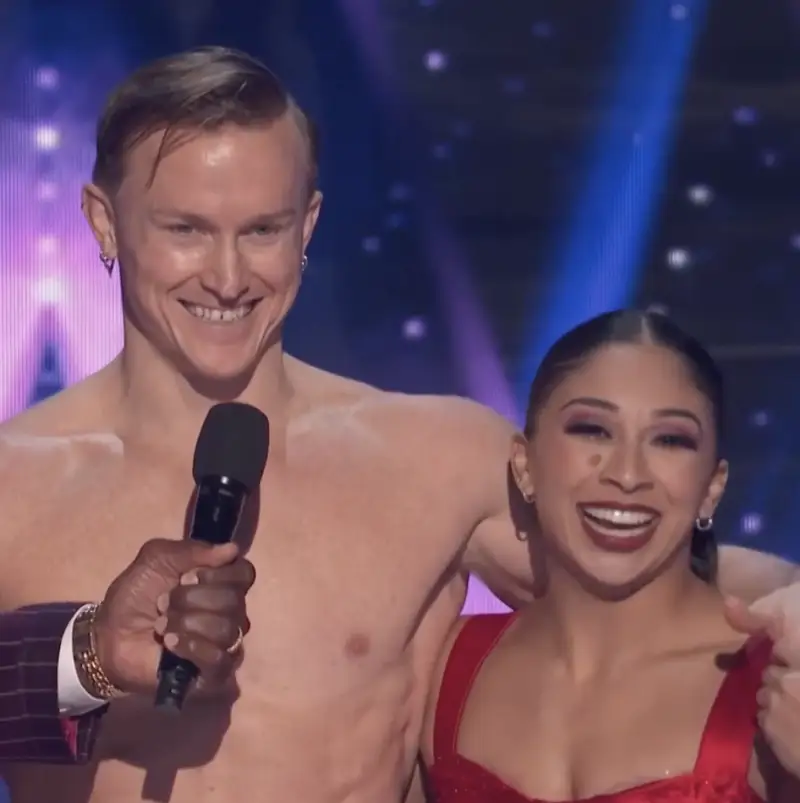
The performers stepped onto the stage and immediately created a sense of anticipation. There was no complicated set filled with equipment surrounding them.
Instead, the centerpiece of the entire act was a single rope hanging high above the stage.
The judges watched carefully.
At first, it was difficult to imagine how two performers could create an entire routine using such a simple piece of equipment.
Then they began climbing.
As they moved higher above the stage, the audience quickly realized that this was not going to be an ordinary acrobatic performance.
The performers began using the rope to lift themselves into the air, creating increasingly difficult shapes and movements.
The height alone was enough to make the audience nervous.
There was no large safety net visible beneath them.
Every movement appeared to depend on their strength, balance, coordination, and trust in one another.
The judges watched with complete concentration.
As the routine continued, the performers began swinging through the air.
Their movements were graceful, but there was also an unmistakable sense of danger.
A single mistake could have serious consequences.
That tension made the performance even more captivating.
The audience watched silently as the performers climbed, swung, and released themselves from the rope before reconnecting with it.
The choreography required extraordinary timing.
Both performers needed to know exactly when to move and when to trust their partner.
Their coordination was remarkable.
At several points, one performer appeared to release their grip while the other continued holding the rope.
The audience reacted with gasps.
The performers, however, remained completely focused.
They continued moving through the routine with confidence and precision.
As they climbed higher, the visual impact became even greater.
The stage lights created a dramatic atmosphere beneath them, making the performers appear to float above the audience.
The rope became their entire world.
They used it to swing, climb, balance, and create impressive aerial shapes.
One of the most remarkable elements of the performance was the trust between the two performers.
Aerial acts require an extraordinary level of communication.
Each person must know exactly what the other is going to do.
They must also have complete confidence that their partner will be there at the right moment.
The slightest hesitation could interrupt the routine.
But these performers moved as though they were connected by instinct.
Their movements were smooth and synchronized.
The judges appeared increasingly impressed.
What started as a simple rope routine had become an incredibly ambitious aerial performance.
The audience could barely look away.
Every time the performers reached a new height or attempted another difficult move, the tension increased.
Then came one of the most dramatic moments.
One performer released from the rope and soared through the air.
For a brief moment, it looked as though they were simply falling.
Then they reached the rope again.
The audience erupted.
The judges reacted with shock and excitement.
It was the kind of moment that makes live performances so powerful.
There was no opportunity to pause and try again.
Everything was happening in real time.
The performers had to execute every movement exactly as rehearsed.
As the routine continued, the difficulty increased once more.
The performers began creating more complicated shapes high above the stage, using their bodies and the rope to form visually striking positions.
The audience remained completely captivated.
The stage looked almost like a giant aerial playground, but the physical demands of the routine were enormous.
Strength was essential.
So was flexibility.
But perhaps most importantly, the performers needed incredible concentration.
They couldn’t afford to become distracted by the audience or the judges.
Every movement required precision.
The music and lighting added to the drama.
The dark stage was illuminated with bright blue and purple lights, creating a dreamlike environment around the performers.
The contrast between the beautiful visuals and the dangerous movements made the routine even more memorable.
As the performance approached its final section, the tension reached its highest point.
The performers prepared for one of their most difficult sequences.
The audience seemed to know that something major was coming.
Then they launched into the finale.
The movements became faster and more dramatic.
One performer swung away from the rope while the other maintained control.
They appeared to fly through the air.
The audience reacted with excitement as the final sequence unfolded.
The judges watched in disbelief.
When the performers finally completed the routine, the reaction was immediate.
The audience erupted into applause.
The judges appeared genuinely stunned by what they had witnessed.
The performance had delivered everything a great aerial act should: danger, beauty, athleticism, trust, and extraordinary control.
What made it especially impressive was the simplicity of the equipment.
There was no complicated machine creating the spectacle.
There was just one rope and two highly trained performers.
Everything else came from their strength, skill, and courage.
The routine demonstrated that an ordinary object can become the foundation for an extraordinary performance when it is placed in the hands of people who have mastered their craft.
The performers didn’t simply climb a rope.
They turned it into a stage.
They used it to create moments of suspense, beauty, and genuine amazement.
And they kept the judges and audience holding their breath from beginning to end.
By the final move, everyone in the room had witnessed something unforgettable.
Two performers.
One rope.
And an aerial routine that pushed the limits of strength, trust, and human ability.