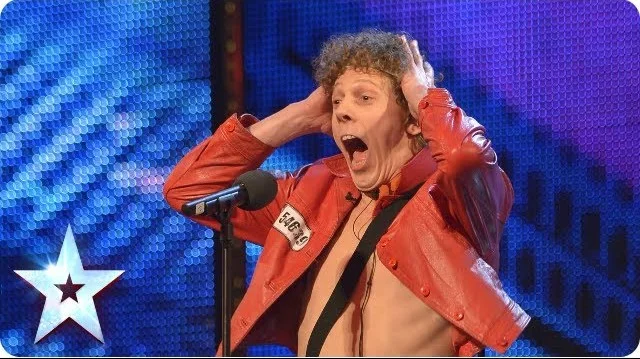
The stage of Britain’s Got Talent has seen its fair share of eccentricities over the decades, but few moments perfectly captured the show’s chaotic, lighthearted spirit quite like Week 6 of the 2013 auditions. Enter Maarty Broekman, a flamboyantly charming Dutch performer who proved that you don’t just need a great voice or a wild stunt to capture the nation’s attention—sometimes, all you need is a keytar and an unfiltered crush on a judge.
An Unconventional Entrance
When Maarty first stepped onto the BGT stage, the audience and judges weren’t entirely sure what to expect. Dressed with a quirky, retro-pop flair and slinging a keytar—the ultimate 1980s hybrid of a keyboard and a guitar—over his shoulder, he exuded an immediate, unbothered confidence.
Before he even struck his first chord, Maarty’s playful energy filled the auditorium. What followed was a performance that successfully blurred the lines between genuine musical performance, stand-up comedy, and performance art.
Mission: Win Over Alesha Dixon
While the audience was laughing and clapping along to the synth-heavy, comedic track, it quickly became apparent that Maarty had a very specific target audience of one: judge Alesha Dixon.
With a cheeky smile and laser-focused eye contact, Maarty directed the most flirtatious elements of his routine straight toward the judges’ panel. He played up his European charm, using his keytar as a musical extension of his courtship.
The Panel’s Reaction
The dynamic created an instantly viral television moment:
-
Alesha Dixon was visibly flattered and kept in stitches, laughing through the blatant, good-natured serenading.
-
Simon Cowell, Amanda Holden, and David Walliams watched in amusement as Maarty completely bypassed them to win over their colleague.
-
The Audience fell in love with his sheer audacity, cheering on his relentless, tongue-in-cheek attempt to woo the pop star.
The Legacy of the Act
Ultimately, Maarty Broekman’s audition became a textbook example of what makes the Got Talent franchise so enduring. It wasn’t technically flawless, nor was it a traditional display of high-art talent. Instead, it was an incredibly memorable piece of pure entertainment.
Maarty weaponized eccentricity and localized it into a fun, interactive narrative that had the entire room—and millions of viewers at home—smiling from ear to ear.