THE BRACELET SHE SHOULDN’T KNOW
THE LAVENDER
At 5:12 on a warm Saturday afternoon, Victoria Laurent stood beneath the striped awning of a flower stall in Brooklyn, holding a cup of iced coffee and pretending she had nowhere else to be.
Golden sunlight spilled between the buildings.
Wooden stalls overflowed with lavender, roses, tulips, hydrangeas, and buckets of wildflowers.
People moved slowly through the market.
Couples.
Families.
Tourists.
Children carrying paper-wrapped bouquets.
Victoria came there whenever the week had been too loud.
At thirty-six, she had built a life that looked calm from the outside.
Elegant apartment.
Successful career in museum development.
Friends who invited her to dinners she often canceled.
A mother she called every Sunday.
And one unanswered question she had carried since childhood.
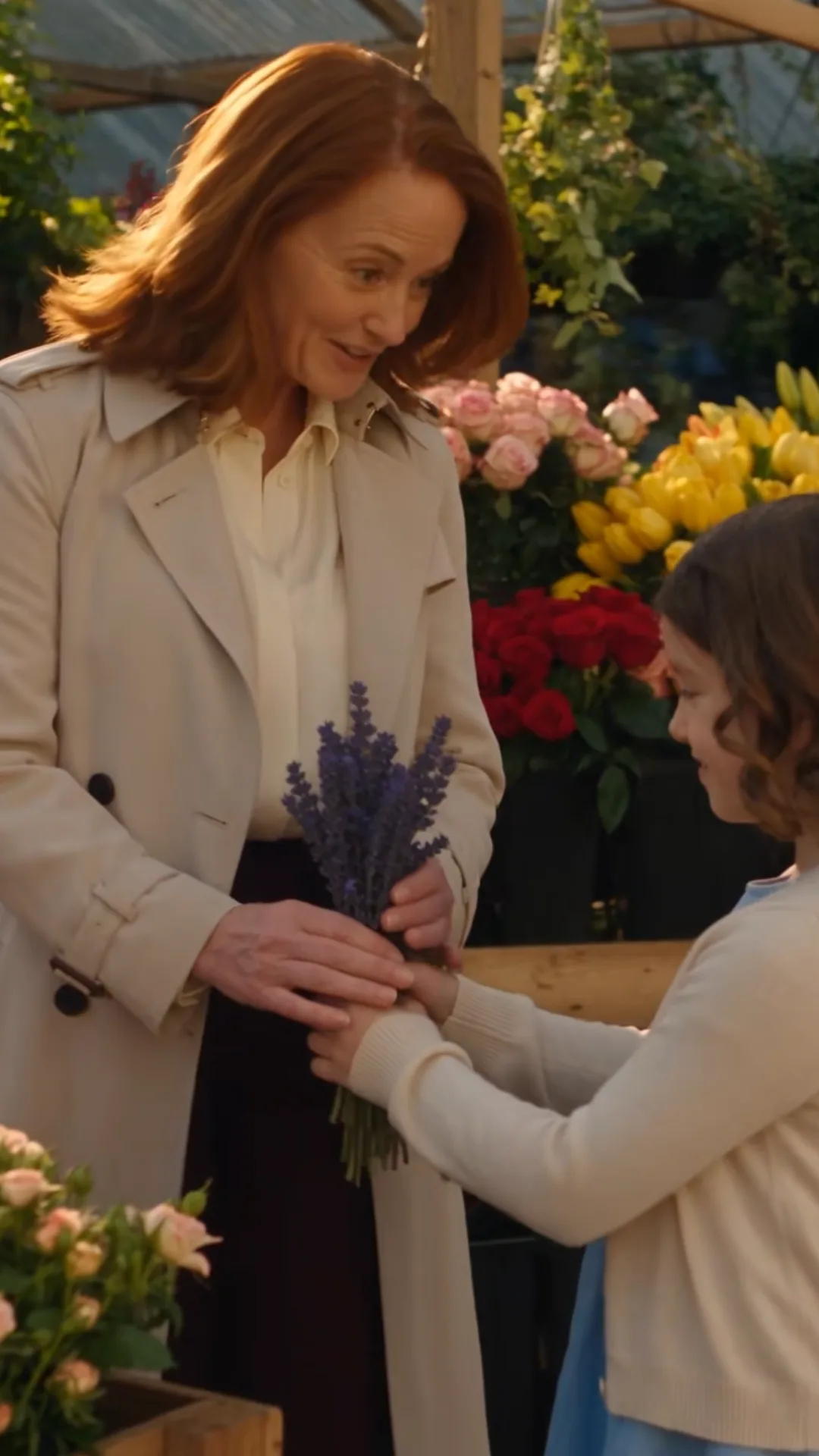
Victoria wore a cream trench coat over an ivory blouse and dark trousers.
On her left wrist was an antique gold bracelet.
It was the one piece of jewelry she never removed.
Her grandmother had given it to her when she turned eighteen.
According to family tradition, the bracelet had belonged to Laurent women for more than a century.
The design was unusual.
A narrow gold chain interrupted by three small oval links, each engraved by hand.
Inside the clasp, almost invisible unless someone knew where to look, was one word.
Laurent.
Victoria was examining white roses when a small voice came from behind her.
“Excuse me, ma’am. These are for you.”
She turned.
A little girl stood one meter away.
Seven years old.
Curly brown hair.
Light-blue dress.
Thin cream cardigan.
White shoes.
She held a small purple lavender bouquet with both hands.
Victoria blinked.
“For me?”
The girl nodded.
Victoria bent slightly.
“Oh… thank you.”
She accepted the lavender carefully.
The child released it only after Victoria had a secure grip.
Victoria smiled.
“What’s your name?”
“Emma.”
“I’m Victoria.”
Emma smiled back.
Victoria transferred most of the lavender into her right hand.
As she did, the sleeve on her left arm slipped back.
Sunlight caught the bracelet.
Emma’s eyes dropped.
Her smile disappeared.
Not from fear.
Recognition.
She pointed.
“My mom has the exact same bracelet.”
Victoria looked down.
For a second, she almost laughed.
The bracelet had been copied before.
Vintage jewelry repeated patterns.
Coincidences happened.
She lifted her wrist slightly.
“That’s impossible. It’s been in my family for generations.”
Emma studied it.
Then looked directly into Victoria’s eyes.
“It says ‘Laurent’ inside, right?”
Victoria stopped breathing.
The market continued around them.
A bicycle bell.
Paper wrapping.
Footsteps.
Someone laughing near the tulip stand.
But Victoria heard almost none of it.
Her fingers tightened around the lavender stems.
The polite smile slowly disappeared.
A small inhale.
Then another.
Her eyes became wet.
“Where is your mother?”
Emma looked toward the far end of the flower market.
Victoria followed her gaze.
And saw a woman arranging roses at a wooden stall.
The woman turned.
Victoria’s world stopped.
—
## PART 2 — THE WOMAN AT THE ROSE STALL
The woman was perhaps thirty-nine.
Chestnut-brown hair.
Simple white blouse.
Olive-green apron.
No expensive jewelry visible.
She stood behind a table covered with red and cream roses.
For several seconds, Victoria could not understand why the woman looked familiar.
Then memory moved faster than logic.
A photograph.
Not one Victoria had seen recently.
One she had found when she was thirteen.
Hidden inside an old book in her grandmother’s study.
Two little girls standing beside a lake.
One was Victoria’s mother, Claire.
The other girl had been older.
Dark hair.
Same eyes.
Victoria had asked her grandmother:
“Who’s this?”
Her grandmother took the photograph from her.
Then said:
“No one you need to know.”
The picture disappeared the next day.
Victoria never saw it again.
But she remembered the face.
Now that face was older.
Standing twenty yards away.
Emma waved.
“Mom!”
The woman looked toward her daughter.
Then at Victoria.
Then at the bracelet.
Her expression collapsed.
Not dramatically.
Just enough.
Victoria saw recognition.
Fear.
And something that looked like grief.
The woman stepped from behind the stall.
Emma ran to her.
“Mom, she has your bracelet!”
The woman placed one hand protectively on Emma’s shoulder.
“Emma.”
Victoria walked toward them.
Still holding the lavender.
Her left wrist felt suddenly heavy.
“What’s your name?”
The woman looked at her.
“Mara.”
Victoria swallowed.
“Mara what?”
The woman hesitated.
Then:
“Mara Laurent Carter.”
Victoria’s knees nearly weakened.
Laurent.
The same name.
The same bracelet.
The same hidden photograph.
Victoria stared.
“How?”
Mara looked at Emma.
Then back at Victoria.
“Not here.”
Victoria’s voice trembled.
“Who are you?”
Mara closed her eyes for one second.
When she opened them, she looked directly at Victoria.
“Your mother’s sister.”
—
## PART 3 — THE AUNT WHO DIDN’T EXIST
Victoria had grown up believing her mother, Claire Laurent, was an only child.
Every birthday.
Every Christmas.
Every family history.
One daughter.
Claire.
No sister.
No aunt.
No Mara.
Victoria’s grandfather had died before she was born.
Her grandmother, Eleanor Laurent, ruled the family with quiet precision.
Old money.
Old expectations.
Old silences.
Victoria remembered her mother asking questions sometimes.
Why certain summers were never discussed.
Why her father had burned letters.
Why Eleanor refused to visit Vermont.
Victoria assumed these were ordinary family tensions.
They were not.
Mara invited Victoria to a café across the street after closing the stall early.
Emma sat beside her mother eating a cookie.
Victoria placed the lavender on the table.
Then slowly removed her bracelet.
She set it between them.
Mara stared at it.
Then reached into her canvas handbag.
Not for another bracelet.
For a photograph.
Old.
Creased.
Faded.
Two girls stood beneath a maple tree.
One around eleven.
The other around six.
The younger girl was Claire.
The older one was Mara.
Both wore matching gold bracelets.
Victoria stared at the image.
“My mother had one?”
Mara nodded.
“So did I.”
“Where is yours?”
Mara looked toward Emma.
“At home.”
Victoria’s voice sharpened.
“Why did no one tell me about you?”
Mara’s eyes became wet.
“Because your grandmother made sure they wouldn’t.”
—
## PART 4 — 1987
Mara Laurent was born five years before Claire.
Their father, Thomas Laurent, owned a successful architectural firm.
Their mother, Eleanor, came from a wealthy Boston family.
From the outside, they were perfect.
Inside, the marriage was collapsing.
Thomas drank.
Eleanor controlled everything.
Money.
Children.
Appearances.
Mara was eleven when the secret exploded.
Thomas had another family.
Not another wife.
A son.
Born before Claire.
Eleanor discovered that Thomas had been secretly supporting the boy and his mother for years.
The marriage became war.
Mara sided with her father.
Not because she understood adultery.
Because she loved him.
Claire, only six, stayed close to Eleanor.
Then Thomas died suddenly in a car accident.
Everything fractured.
Eleanor blamed Mara for “betraying the family.”
Mara was sent to live with Thomas’s sister in Vermont.
Officially, it was temporary.
It became permanent.
At first Claire wrote letters.
Mara kept every one.
Then the letters stopped.
Years later, Mara learned why.
Eleanor had intercepted them.
She told Claire that Mara did not want contact.
She told Mara that Claire had chosen their mother.
Both girls believed they had been rejected.
By the time they became adults, silence had hardened into history.
—
## PART 5 — CLAIRE’S SEARCH
Victoria felt sick.
“My mother looked for you.”
Mara stared.
“What?”
“She used to ask about someone.”
Victoria’s voice broke.
“I thought she meant an old friend.”
Claire Laurent had died nine years earlier after a sudden illness.
During the final year of her life, she became obsessed with old family records.
Storage boxes.
Letters.
Property documents.
She asked Victoria to help search Eleanor’s attic.
One night Claire found an envelope.
Victoria remembered the reaction.
Her mother sat on the floor crying.
When Victoria asked why, Claire simply said:
“I think my mother lied to me.”
Victoria never knew what the letter contained.
After Claire died, Eleanor cleared the attic before Victoria returned.
Now Victoria understood.
“Did she contact you?”
Mara shook her head.
“No.”
Victoria’s eyes filled.
“What if she tried?”
Mara looked down.
Neither woman spoke.
Emma stopped eating.
She sensed the room had become serious.
Victoria wiped one tear away.
“My mother died thinking you didn’t want her.”
Mara’s face broke.
“And I spent thirty years thinking the same thing.”
—
## PART 6 — THE SECOND BRACELET
Mara invited Victoria home that evening.
A small apartment above a bakery.
Warm.
Crowded.
Plants in the windows.
Emma’s drawings on the refrigerator.
Nothing like the Laurent home Victoria had grown up in.
Mara opened a wooden box.
Inside was the second bracelet.
Same antique gold.
Same oval links.
Same hand engraving.
Victoria held hers beside it.
Identical.
Mara turned hers over.
Inside:
Laurent.
Victoria’s hands trembled.
“My grandmother told me only one survived.”
“She lied.”
“She said the other was lost during a move.”
Mara smiled sadly.
“She liked stories where missing people sounded like missing objects.”
Victoria looked at her.
That sentence stayed with her.
Mara handed Victoria another envelope.
Inside were letters.
Dozens.
From Claire.
Most written when she was a child.
Dear Mara,
Mom says you’re busy.
Dear Mara,
I miss you.
Dear Mara,
Are you mad at me?
Then nothing.
The final letter was never mailed.
Claire had been thirteen.
I don’t know why you stopped writing. I hope you know I still love you.
Victoria cried openly.
Mara did too.
Emma stood quietly in the hallway, watching two women discover that a family had stolen decades from them with silence.
—
## PART 7 — ELEANOR LAURENT
Eleanor was eighty-seven and still alive.
Victoria had lunch with her every other Sunday.
She almost canceled the next one.
Then decided against it.
She wanted answers.
Eleanor lived in the same stone house where Victoria’s mother had grown up.
The same staircase.
Same portraits.
Same silver-framed family photographs.
No Mara.
Victoria entered wearing the bracelet.
Then placed a second bracelet beside it on the dining table.
Eleanor froze.
For several seconds, she looked older than Victoria had ever seen her.
“Where did you get that?”
“From Aunt Mara.”
Eleanor’s face tightened.
“Don’t call her that.”
Victoria stared.
“She’s my aunt.”
“She abandoned this family.”
“No.”
Victoria placed Claire’s letters on the table.
“You erased her.”
Eleanor looked away.
Victoria continued.
“Mom spent her life thinking Mara rejected her.”
Silence.
“Mara thought the same.”
Eleanor finally spoke.
“I protected Claire.”
“From what?”
“Chaos.”
“By taking away her sister?”
Eleanor’s composure cracked.
“You don’t know what your grandfather did.”
“This isn’t about him.”
“It was always about him.”
“No.”
Victoria leaned forward.
“This is about what you did after he died.”
Eleanor said nothing.
For the first time in Victoria’s life, her grandmother had no controlling answer.
—
## PART 8 — WHY ELEANOR DID IT
Eventually Eleanor spoke.
She admitted everything.
Mara reminded her of Thomas.
Same stubbornness.
Same defiance.
Same refusal to obey.
After Thomas died, Eleanor could not separate the child from the betrayal.
Sending Mara away felt temporary at first.
Then distance became easier.
When Claire asked questions, Eleanor answered with resentment.
When letters arrived, she hid them.
When Mara wrote, Eleanor intercepted those too.
Years passed.
Then shame became another reason not to tell the truth.
Every additional year made confession harder.
Eleanor told herself both girls had moved on.
They had not.
Victoria listened.
Then asked:
“Did my mother find out before she died?”
Eleanor looked down.
“Yes.”
Victoria felt the answer like a physical blow.
“When?”
“Six months before.”
“And?”
“She wanted Mara’s address.”
“Did you give it to her?”
Eleanor closed her eyes.
“No.”
Victoria stood.
For the first time in her life, she looked at her grandmother and felt nothing but disappointment.
“Why?”
Eleanor whispered:
“I was afraid she would never forgive me.”
Victoria’s voice became cold.
“So you made sure she died before she had the chance.”
—
## PART 9 — THE LETTER CLAIRE NEVER SENT
Three days later, Eleanor called Victoria.
There was one more letter.
Hidden.
Claire had written it shortly before she died.
Eleanor had kept it.
Not destroyed.
Not mailed.
Victoria collected it.
She did not open it.
She brought it directly to Mara.
They sat together at the kitchen table.
Mara unfolded the pages.
Claire’s handwriting had become shaky.
Mara,
If this reaches you, I’m sorry it took me so long to learn that neither of us was the one who disappeared.
I believed you chose to leave me.
I know now that may not be true.
I don’t know whether you want to see me.
I only need you to know that I never stopped wondering where you were.
And I never stopped loving you as my sister.
Mara could not finish aloud.
Victoria did.
By the end, both women were crying.
Emma entered quietly.
She climbed onto her mother’s lap.
Mara held her.
Then looked at Victoria.
“Your mother found me.”
Victoria nodded.
“Just too late.”
Mara shook her head.
“No.”
She held the letter against her chest.
“She found the truth.”
That was not enough.
But it was something.
—
## PART 10 — EMMA’S QUESTION
Emma eventually understood that Victoria was family.
At least in the way children understand complicated adult relationships.
One evening she asked:
“So you’re Mom’s niece?”
Victoria laughed through tears.
“Yes.”
“And I’m your cousin?”
“Yes.”
Emma thought about that.
Then asked:
“Why didn’t we know?”
Mara and Victoria looked at each other.
Neither wanted to explain Eleanor.
Victoria answered simply:
“The grown-ups made a mistake.”
Emma frowned.
“For thirty years?”
Victoria almost laughed.
“Yes.”
Emma shook her head.
“That’s a really long mistake.”
It was.
Children often found the clearest language.
—
## PART 11 — THE MARKET AGAIN
Six months after the first meeting, Victoria returned to the flower market.
Same stall.
Same late-afternoon light.
Mara arranged roses.
Emma sat nearby doing homework.
Victoria carried two coffees.
And lavender.
Mara smiled.
“You brought your own flowers this time.”
Victoria looked at Emma.
“Someone made me like them.”
Emma grinned.
Victoria still wore the bracelet.
Mara wore hers now too.
Not every day.
But sometimes.
They did not pretend the bracelets were magical.
They had not fixed anything.
They could not restore lost childhood.
Could not give Claire back.
Could not erase Eleanor’s decisions.
But they became reminders.
Not of the Laurent family name.
Of what silence could cost.
—
## PART 12 — ELEANOR’S LAST REQUEST
Eleanor’s health declined the following year.
Victoria continued visiting.
Less often.
Mara refused at first.
Then changed her mind.
Not for Eleanor.
For herself.
She went once.
Eleanor cried the moment she saw her.
“Mara.”
Mara stood near the bed.
Older now than Eleanor had been when she sent her away.
For a long time, neither spoke.
Then Eleanor said:
“I’m sorry.”
Mara nodded.
“I know.”
“Can you forgive me?”
Mara looked at her.
“I don’t know.”
Eleanor began crying.
Mara did not rush to comfort her.
Forgiveness was not something the person who caused the wound could schedule.
Mara stayed fifteen minutes.
Before leaving, she placed a photograph beside Eleanor’s bed.
The old photograph of the two sisters beneath the maple tree.
Claire and Mara.
Together.
That was all.
—
## PART 13 — VICTORIA’S MOTHER
Victoria began collecting everything she could find about Claire’s childhood.
Photographs.
Letters.
School records.
Stories from Mara.
She discovered a version of her mother she had never known.
Claire hated carrots.
Loved thunderstorms.
Was terrible at riding bicycles.
Followed Mara everywhere.
Once broke a window throwing a baseball and blamed the dog.
Mara told the stories.
Victoria laughed.
For nine years, grief had frozen Claire into the person she was when she died.
Mara gave Victoria her mother back as a child.
That became the greatest gift of the reunion.
Not the bracelet.
Not the family name.
Stories.
—
## PART 14 — EMMA’S BRACELET
On Emma’s tenth birthday, Victoria gave her a small box.
Inside was not one of the antique bracelets.
Those belonged to the past.
This one was new.
Simple gold.
Three small oval links inspired by the originals.
Emma opened it.
Inside the clasp was one word.
Not Laurent.
Family.
Emma looked up.
“Why doesn’t it say Laurent?”
Victoria smiled.
“Because names aren’t what make people family.”
Mara’s eyes became wet.
Emma put it on.
Then immediately asked whether she could wear it while playing soccer.
Both women shouted:
“No!”
Emma laughed.
—
## EPILOGUE — THE BRACELET SHE SHOULDN’T KNOW
For years, Victoria told the story beginning with the bracelet.
A little girl.
A lavender bouquet.
One impossible sentence.
“My mom has the exact same bracelet.”
But eventually she understood that the bracelet was only the key.
The real story was about two sisters separated by someone else’s anger.
A child taught to believe she had been abandoned.
Another child taught the same lie.
A mother who discovered the truth too late.
A granddaughter who inherited both jewelry and silence.
And another little girl innocent enough to notice what adults had spent decades hiding.
Emma had no idea she was revealing a family secret.
She simply recognized something familiar.
That innocence was what made the moment so powerful.
Adults are skilled at explaining away contradictions.
Children ask direct questions.
Why does she have Mom’s bracelet?
Why does it say Laurent?
Why didn’t you know each other?
Why did grown-ups lie?
No sophisticated answer made the loss smaller.
Victoria continued wearing her bracelet.
Mara wore hers on important days.
Emma wore her new one only when her mother allowed it.
Years later, after Eleanor was gone, Victoria and Mara returned together to the old Laurent house.
They removed the family portraits from storage.
Among them they found a small photograph neither had seen before.
Mara at eleven.
Claire at six.
Both holding lavender.
Victoria stared.
“You liked lavender?”
Mara laughed.
“Claire did.”
Victoria looked down at the bracelet on her wrist.
Then thought about that first afternoon.
Emma holding purple flowers.
Sunlight.
The gold clasp.
One name.
Laurent.
She smiled.
Sometimes the past does not return with a dramatic confession.
Sometimes it walks toward you at a flower market.
Holding lavender.
And asks a question no stranger should have been able to ask.