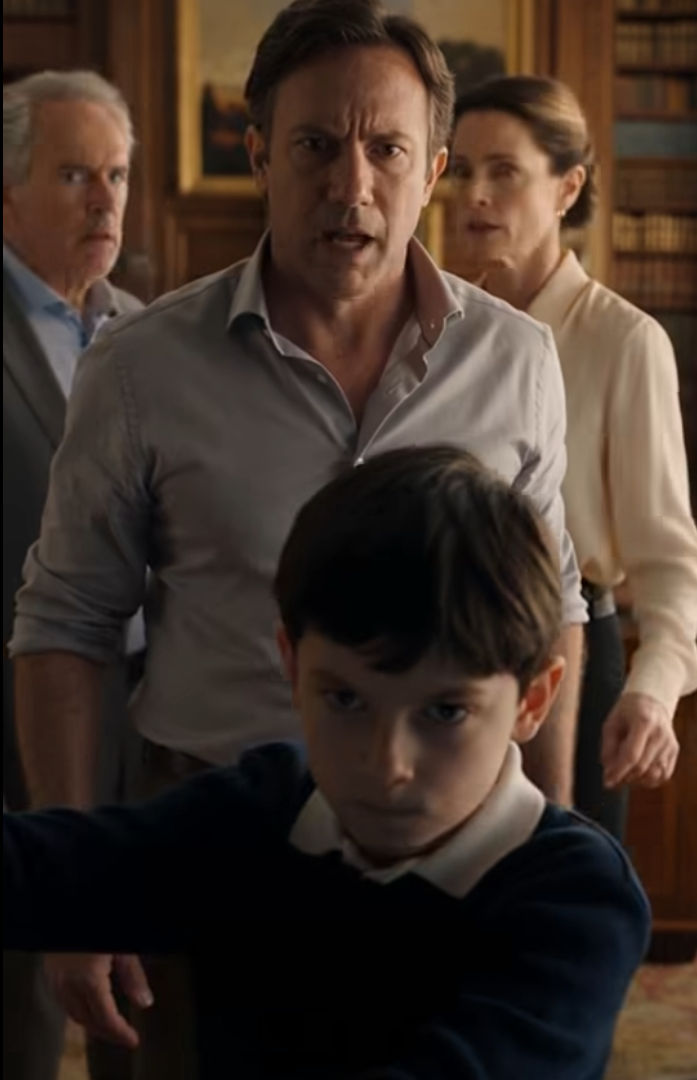
Eleven-year-old Eli Carrow hears three knocks behind a giant family portrait in his grandfather’s Hudson Valley mansion and smashes the frame open. Inside a sealed service elevator is Arthur Carrow—bound, taped, dehydrated, and very much not in the private-care facility Eli’s aunt Susan described. As Eli’s father Marcus uncovers forged documents, stolen company money, and a scheme built around one missing signature, the family story collapses into a criminal case—and what were Susan and Vincent planning to do before Eli heard him?
The next four minutes ran on their own, without anybody choosing anything.
Marcus got down on his knees in the opening. The shaft smelled. That was the first fact, and it was the one he would not describe to anyone, ever, not to the investigator and not to the lawyers and certainly not to his son: it smelled like a room where a person had been kept.
The tape across his father’s mouth was silver duct tape, doubled, and it had been put on badly, folded over on one edge. Marcus got a fingernail under the fold.
“This is going to hurt,” he said. It was the only thing he could think of to say.
It hurt. Arthur made a sound through his nose and then his mouth was free and he did not say anything at all for about six seconds. His lips were cracked white at the corners. He worked his jaw twice.
Then he said, “What day is it.”
Not help me. Not his son’s name.
“It’s Thursday,” Marcus said.
“The date.”
“The tenth. September tenth.”
Arthur closed his eyes. His head went back against the metal wall with a soft knock, and Marcus heard himself make a noise he did not recognize, because that was the sound. Two quick, one slow, was what Eli had said. This was one, and it was the same sound.
“Then it isn’t done yet,” Arthur said.
—
Marcus’s hands were not working properly. The zip ties on his father’s wrists were the wide white kind, pulled tight enough that the skin had gone shiny and bunched over them, and there was no give at all. He put his thumbs under them and pulled anyway, stupidly, twice, before he stopped.
“Eli. Kitchen drawer by the stove. Scissors.”
Eli went. He went fast, and Marcus registered somewhere behind everything else that his son had not made one sound since the doors opened.
Susan had not moved from where she was standing.
“He fell,” she said.
Marcus turned his head.
“On the thirtieth. He came down the back stairs at night and went into the sideboard. He cut his head.” She said it evenly, in order, like someone reading off a chart, and her hands were folded in front of her. “He was confused after that. He kept going outside. He went down the drive twice in the middle of the night, Marcus. Twice. I couldn’t sleep. I couldn’t leave the house.”
“He’s tied up.”
“I know how it looks.”
“He’s tied up, Susan.”
“I know how it looks,” she said again.
Vincent had moved to the table. Not far — three steps — but he was standing at the table with one hand flat on the top folder, and when Marcus looked at him he took the hand off and put it in his jacket pocket.
Eli came back with kitchen shears.
Marcus cut the ties. They came apart with a snap and Arthur’s arms fell into his lap and he made a small involuntary noise at the pain of that, and then he lifted his right hand about four inches and stopped, and Eli reached in and took it.
“Hey, kid,” Arthur said.
“Hey,” Eli said.
That was the entire conversation.
—
Marcus took his phone out. His thumb missed the screen twice.
“Marcus,” Susan said.
He did not answer her. He said, “My father has been held in a — ” and then he had to stop and look at the shaft, at the bucket and the blanket, because he genuinely did not have a word for what he was looking at. “There’s a service elevator in the wall. He’s been in it. I don’t know how long. He’s conscious. He’s dehydrated. Calder House, four-forty Vaughn Hill Road, Quarry Falls.”
The dispatcher asked him whether the people who did it were still in the residence.
Marcus looked at his sister.
She looked back at him. She was not begging. That was the thing he could not get past afterward, in the weeks when he replayed it: there was no plea in her face. There was calculation. She was standing in her father’s living room doing arithmetic about him.
“Yes,” he said. “They’re here.”
—
The ambulance took nineteen minutes. The first trooper took twenty-two.
In that time Marcus learned three things, and later he wrote them down in a notebook in an ER waiting room because he was afraid of losing them.
The first was that there were two empty water bottles by Arthur’s hip and a crate of them at the back of the shaft with the shrink-wrap cut open, and a thermos, and a supermarket sleeve of plastic spoons. Nobody had been starving him. Somebody had been feeding him, carefully, for a period of time long enough to require a system.
The second was the tape.
When Marcus finally pulled the whole roll out from under the blanket — he should not have touched it, they told him that later, twice — he saw the printing on the core. BELL & CORLISS FINE ART & ESTATES, HUDSON NY, and a phone number. Packing tape from Vincent’s auction house. Not bought for this. Brought from a van.
The third was the marks.
Arthur’s wrists had two sets. Under the fresh red line from the zip ties there were older marks, faded to yellow-brown, in a different place and a different width — soft, wide, from something like a bathrobe cord — and they were healing.
The tape and the ties were new.
His sister had put those on him tonight, after she got the call that Marcus was two hours out, and not before.
—
“Sir. Step back from the opening, please.”
The trooper’s name tape said DEROSIER. He was young and he was very calm and he asked Marcus to sit down in a chair in the front hall, which Marcus did, and then he asked Eli to sit in the kitchen with a second trooper, which Eli did without being asked twice.
Marcus watched the paramedics work in the mouth of the shaft. They put a line in his father’s arm. Arthur answered their questions in a voice that kept losing its bottom and coming back. Name. Arthur Carrow. Date of birth. He gave it. Do you know where you are. He said, “My house.”
Do you know what year it is.
Arthur said the year, and then he said, “Ask me the harder ones.”
The paramedic, a woman of about thirty with her hair scraped back, said, “Okay. Who’s the president.”
“No,” Arthur said. “Ask me who has power of attorney.”
She looked up at the trooper. The trooper wrote something down.
Arthur turned his head on the backboard and found Marcus in the hall doorway.
“Did you sign anything,” he said. “Tonight. Did you sign anything.”
“No.”
“Don’t.”
“Dad—”
“They needed you,” Arthur said. “That’s the only reason there was a reason.” His eyes went past Marcus, down the hall, to where Susan was standing with her arms crossed under the light, talking quietly and steadily to a second trooper who was writing everything down. “They have seventy-eight percent and they need ninety. That’s why I’m alive, Marcus. Don’t ever be confused about that part.”
Then they lifted him and carried him out through the front door of the house he had been born in, and the last thing he did before the doors of the ambulance closed was look back at the torn portrait on the floor, the four generations of them on the steps, face-up on the rug with a footprint across it.