At 7:46 on a rainy Thursday evening, Sofia Ramirez had exactly twenty-three dollars and eighteen cents left until payday.
She knew the amount because she had checked twice during her break.
Eight dollars had to go toward gas.
Ten toward the prepaid phone bill she shared with her younger brother.
The rest was supposed to buy something cheap for dinner after her shift.
Probably rice.
Eggs.
Maybe tortillas if they were on sale.
She was nineteen years old, working thirty-four hours a week at an airport convenience store inside Miami International Airport while taking two community-college classes online.
There was nothing unusual about her situation.
That was what made it exhausting.
No dramatic tragedy.
No secret inheritance.
No impossible debt.
Just arithmetic.
Rent.
Food.
Gas.
Tuition.
A mother who cleaned hotel rooms near Miami Beach and still insisted she was “fine” whenever Sofia offered money.
A sixteen-year-old brother named Mateo who pretended he did not notice when the refrigerator was almost empty.
And a father who lived three hours north and called often enough to avoid being called absent, but not often enough to make anything easier.
Sofia had learned to count.
Not only money.
Hours.
Miles.
Groceries.
The number of days before a bill was late.
The number of times she could say yes to someone before she had to start saying no.
The airport store where she worked was small but relentless.
Bright coolers.
Candy racks.
Bottled water priced high enough to make passengers complain.
Sandwiches sealed in plastic.
Travel-size toothpaste.
Phone chargers.
Magazines.
Headphones.
A rotating wall of neck pillows that looked ridiculous until someone had a six-hour delay.
The store sat near the flow of passengers heading toward several domestic gates.
At rush hour, the line rarely disappeared.
Suitcases rolled past.
Announcements echoed overhead.
Children cried.
Business travelers stared at screens.
Families argued about boarding groups.
Rain pressed against the large terminal windows, turning runway lights into blue and white streaks.
Sofia liked airports.
Even while working in one.
People were always arriving from somewhere and going somewhere else.
It made her feel, strangely, as though her own life was moving too.
Even on weeks when it clearly wasn’t.
Her manager, Daniel Price, did not share her sentimentality.
Daniel was fifty-one.
White shirt.
Dark tie.
Black trousers.
Manager badge clipped perfectly straight.
He had spent twenty-six years in airport retail.
He knew shrink numbers by week.
Labor percentages by month.
Which snacks disappeared most often.
Which employees stayed five minutes too long on break.
Which airline crews bought coffee before the first morning departure.
He was not cruel.
Not usually.
But he believed rules existed because people became expensive the moment rules became optional.
That belief had hardened over the years.
Sofia had heard him say:
“Kindness is fine. Just don’t put it through my register.”
She never knew whether he was joking.
At 7:46, Harold Bennett entered the store.
Sofia noticed him because he moved as though every step required a small negotiation.
He was around seventy.
Maybe older.
Thin.
Silver-gray hair wet from rain.
Uneven gray beard.
A faded brown coat with frayed cuffs.
Old gray shirt.
Dark trousers torn slightly near one knee.
Scuffed brown shoes.
He carried a small paper bag folded nearly flat.
Nothing about him looked dangerous.
Nothing looked theatrical.
He simply looked tired.
Cold.
And hungry.
Several people glanced at him.
Then away.
Airports had a way of making strangers invisible.
Everyone already had somewhere else to be.
Harold walked past the candy.
Past the drinks.
Stopped in front of the refrigerated sandwiches.
He looked through the glass for a long time.
Not deciding what sounded best.
Deciding what he could afford.
Sofia recognized the difference.
He picked the least expensive turkey sandwich.
Then a bottle of water.
He walked to the register.
Two travelers stood ahead of him.
Sofia worked quickly.
Scan.
Beep.
Card.
Receipt.
Next.
When Harold reached the counter, he placed the sandwich down carefully.
Then the water.
Sofia smiled.
“Hi.”
He nodded.
“Evening.”
She scanned both.
The total appeared.
Harold looked at the screen.
Something in his face tightened.
He reached into one pocket.
Then another.
Pulled out crumpled bills.
Coins.
A receipt.
He began counting.
Once.
Then again.
Sofia waited.
The man behind him shifted impatiently.
Harold counted a third time.
Then stopped.
He looked at the sandwich.
His shoulders lowered.
“I’m short…”
His voice was quiet.
He swallowed.
“Five dollars.”
Sofia looked at the money.
Then at him.
Harold began sliding the sandwich back toward her.
“I’ll just take the water.”
There are moments in life that look smaller than they are because nobody has had time to attach consequences to them yet.
For Sofia, this was one of those moments.
She did not think about morality.
Did not imagine cameras.
Did not think about being rewarded.
She thought about Mateo.
Three years earlier, after their mother lost two weeks of work because of pneumonia, Sofia had watched her brother pretend he was not hungry so she would eat the last frozen dinner.
He had said:
“I already ate.”
She had known he was lying.
Harold had the same look.
Not desperation.
Embarrassment.
The quiet attempt to make hunger look like a personal choice.
Sofia reached into the pocket of her apron.
She had brought five dollars in cash for the vending machine during break.
A single bill.
She placed it on the counter.
“It’s okay.”
Harold looked up.
“I’ve got it.”
He shook his head immediately.
“No.”
“It’s fine.”
“No, miss.”
“It’s five dollars.”
“That matters.”
The sentence made her pause.
He looked at her.
“For you too.”
Sofia smiled faintly.
“Probably.”
Then she pushed the sandwich toward him.
“But you need it more than I do.”
That was when Daniel appeared.
He had been restocking cigarettes behind the restricted counter.
He had seen the bill.
His eyes moved from Sofia’s hand to Harold.
“What are you doing?”
Sofia turned.
“Just covering the difference.”
Daniel’s jaw tightened.
“You don’t do that here.”
Harold began gathering his money.
“It’s all right. I can—”
Daniel raised one hand.
“I’m speaking to my employee.”
Harold stopped.
Sofia felt several passengers watching now.
She hated that.
Nothing had been dramatic until Daniel made it official.
“It’s my money,” she said.
Daniel lowered his voice.
“That’s not the point.”
“What’s the point?”
“The point is you do not mix personal cash with store transactions.”
“I’m not changing the drawer.”
“You’re interfering with a sale.”
Sofia looked at the sandwich.
“He was five dollars short.”
“I can see that.”
“So I paid five dollars.”
Daniel inhaled slowly.
“Sofia.”
The warning was obvious.
But so was the absurdity.
She slid the food toward Harold.
“He needs it more than I do.”
The line went silent.
Not fully.
The airport still existed outside.
Announcements.
Suitcases.
Rain.
But inside that little store, attention gathered.
Daniel saw it too.
A woman near the cooler was watching.
A business traveler near the doorway had stopped scrolling.
A teenager held his phone loosely at chest height.
Daniel disliked public challenges.
Especially from employees.
“Sofia, take off your badge.”
She stared at him.
“What?”
“Your badge.”
She did not move.
“Why?”
“Because you’re done for tonight.”
“Tonight?”
Daniel paused.
Then made the choice that would change far more than he understood.
“No.”
Sofia’s face lost color.
Daniel continued:
“You’re done here.”
A passenger whispered:
“Seriously?”
Daniel heard.
That made him more rigid.
Sofia looked at him for several seconds.
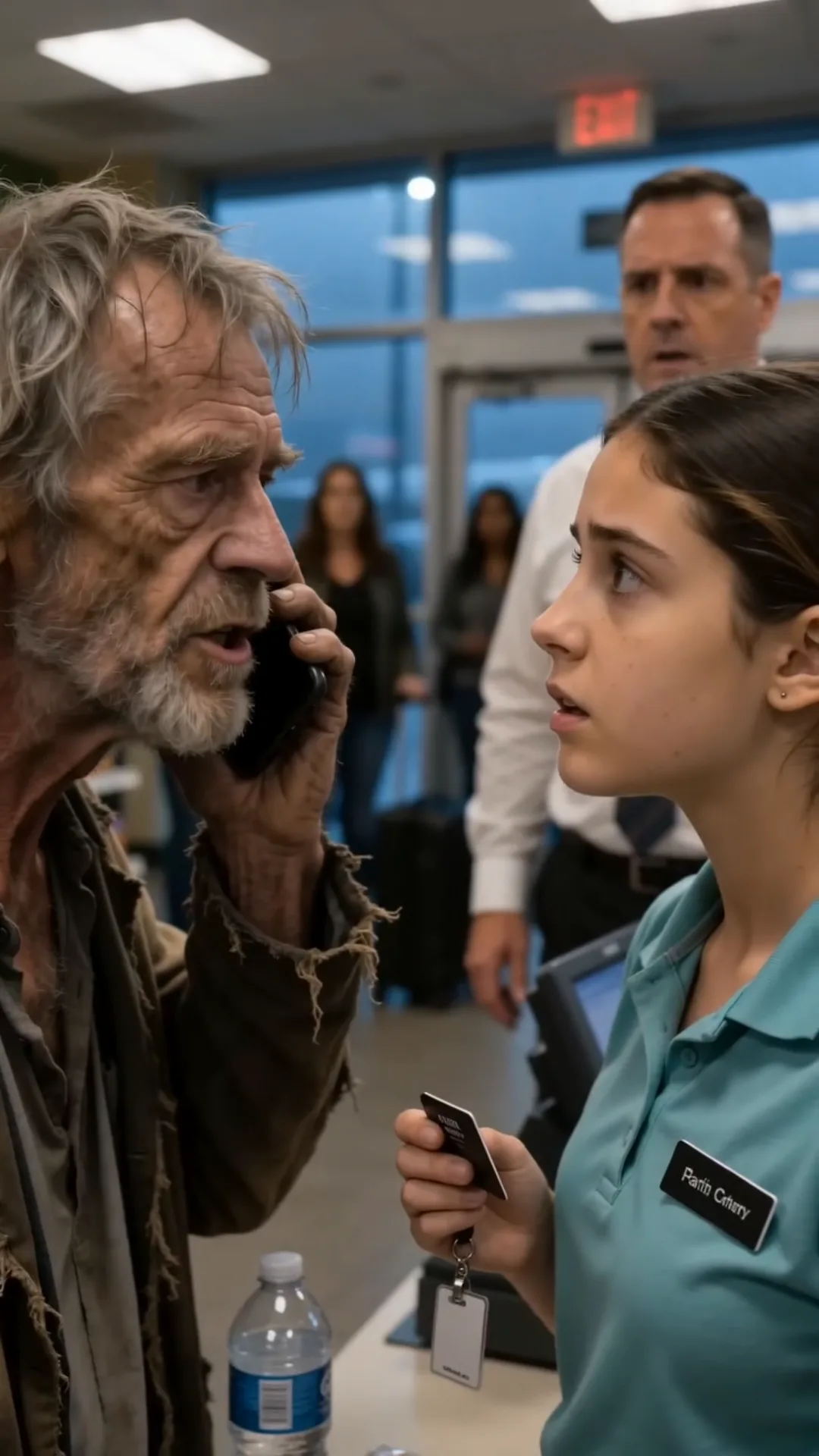
Then slowly reached for the name badge clipped to her teal polo.
She removed it.
Held it in her palm.
No crying.
No yelling.
Just disbelief.
Harold watched everything.
His face looked stricken.
“This is because of me.”
Sofia turned toward him.
“No.”
“It is.”
She shook her head.
“No, sir.”
Then looked at Daniel.
“This is his decision.”
Harold lowered his eyes.
Sofia slid the sandwich and water toward him one last time.
“Please eat.”
Harold took them.
His fingers trembled.
Daniel said:
“Sofia, get your things.”
She nodded.
Then something unexpected happened.
Harold reached deep inside the torn brown coat.
Daniel watched.
So did everyone else.
They expected more crumpled money.
Maybe identification.
Instead, Harold pulled out a black smartphone.
Expensive.
New.
Completely out of place against the rest of him.
Daniel’s expression changed first.
Sofia merely stared.
Harold unlocked it.
His trembling seemed to lessen.
He selected a contact.
Raised the phone to his ear.
When he spoke, his voice was different.
Still quiet.
But no longer embarrassed.
“Don’t sign the contract yet.”
Pause.
He listened.
“No.”
His eyes moved to Sofia.
“Something just changed.”
Daniel stopped breathing normally.
Harold listened again.
Then said:
“I’m at the airport location.”
Another pause.
“Yes.”
He looked directly at Daniel.
“The one near D27.”
Daniel’s face went pale.
Sofia noticed.
Harold ended the call.
Nobody moved.
Daniel finally asked:
“Who did you just call?”
Harold slid the phone back into his coat.
He looked tired again.
But not weak.
“That depends.”
Daniel swallowed.
“On what?”
“On whether you know what contract is being signed tonight.”
Daniel said nothing.
Harold looked at Sofia.
Then at the badge in her hand.
“May I ask your name?”
She almost laughed.
“It was on the badge.”
Harold looked at the badge.
“Sofia Ramirez.”
“Yes.”
He nodded.
Then turned back to Daniel.
“What’s your name?”
Daniel straightened.
“Daniel Price.”
Harold repeated it quietly.
“Daniel Price.”
The way he said it made Daniel uncomfortable.
Harold picked up the sandwich and water.
Then asked:
“Is there somewhere we can sit for five minutes?”
Daniel immediately answered:
“Sir, I need to understand who you are.”
Harold looked at him.
“No.”
A beat.
“You need to understand what you just did.”
Then he turned to Sofia.
“And so do I.”
They sat at two metal tables outside the store.
Daniel remained standing.
Sofia had not gone to collect her things.
She did not know whether she was fired.
Suspended.
Or trapped inside the strangest evening of her life.
Harold unwrapped the sandwich.
He took one bite.
Then another.
Slowly.
Nobody spoke until he had eaten half.
Finally Sofia asked:
“Are you okay?”
Harold looked at her.
That question seemed to surprise him more than anything else.
“Yes.”
Then:
“Better now.”
Daniel said:
“Sir, respectfully, if this is some kind of corporate inspection—”
Harold turned toward him.
“It isn’t.”
Daniel hesitated.
“Then what is it?”
Harold folded the plastic wrapper.
“My name is Harold Bennett.”
Daniel’s face changed.
Sofia saw it.
She still did not recognize the name.
Daniel did.
Harold continued:
“I chair Bennett Meridian Holdings.”
Sofia waited.
Nothing.
Daniel looked as though someone had removed the floor.
Bennett Meridian was not a famous consumer brand.
It did not appear on billboards.
It owned stakes in logistics companies, airport retail concessions, food-service operators and travel infrastructure firms.
For the last six months, it had been negotiating to acquire a controlling interest in Horizon Traveler Retail—the company operating Sofia’s store and forty-eight other airport locations.
The agreement was supposed to be signed that night.
Sofia slowly understood only one thing.
This man mattered to Daniel’s employer.
A lot.
Daniel spoke carefully.
“You’re Harold Bennett.”
“Yes.”
Daniel glanced at the torn coat.
Harold noticed.
“So I’m told.”
Daniel realized what his face had revealed.
“I didn’t mean—”
“I know what you meant.”
Harold ate another bite.
Daniel asked:
“Were you testing us?”
Harold looked genuinely irritated.
“No.”
That answer surprised everyone.
Daniel blinked.
“No?”
Harold placed the sandwich down.
“I didn’t dress this way for you.”
He touched the wet coat.
“My luggage was sent to Atlanta instead of Miami after a weather diversion.”
Sofia listened.
“My overnight bag, wallet and medication pouch were all in the carry-on I was forced to gate-check because the flight was full.”
He pulled out the expensive phone.
“This stayed in my coat.”
Daniel looked confused.
Harold continued:
“My corporate card was frozen this afternoon after a fraud alert.”
He gave a tired half smile.
“Apparently someone in Arizona tried to buy eighteen thousand dollars of electronics with it.”
Sofia almost smiled.
Harold added:
“I had some cash in another pocket from earlier. Less than I thought.”
“So you really didn’t have enough?”
Sofia asked.
“No.”
“And you really were hungry?”
“I hadn’t eaten since breakfast.”
Harold looked at Daniel.
“I was not conducting a morality experiment.”
He leaned back.
“I’m seventy-one years old, soaked, tired, and apparently incapable of keeping track of which bag contains my wallet.”
Daniel looked down.
Harold continued:
“The acquisition was already under review for reasons unrelated to tonight.”
That mattered.
He was not buying a company because a cashier gave him five dollars.
He was not cancelling a hundred-million-dollar transaction because his feelings were hurt.
Reality was more complicated.
And more serious.
“Our team has concerns about Horizon’s staff turnover, complaint handling and management culture.”
Daniel said:
“That’s above my level.”
“Perhaps.”
Harold looked toward the store.
“But culture eventually reaches the register.”
Silence.
He turned to Sofia.
“Why did you pay?”
She shrugged slightly.
“You were hungry.”
“That’s it?”
“Yes.”
“You didn’t know me.”
“No.”
“You couldn’t afford to lose five dollars.”
Sofia looked at him sharply.
“How do you know?”
“Because people who can afford to lose five dollars don’t usually keep it folded alone in an apron pocket.”
She almost smiled.
Harold reached into his coat.
Pulled out a five-dollar bill.
Held it toward her.
She shook her head.
“No.”
“Sofia.”
“No.”
“You loaned me money.”
“I gave it.”
“Then let me give it back.”
“No.”
Daniel stared at both of them.
Harold asked:
“Why not?”
Sofia answered:
“Because now I know you have money.”
Harold blinked.
Then laughed.
It was the first real laugh anyone had heard from him.
“Fair.”
He put the bill away.
Then looked at Daniel.
“Did policy actually require you to fire her?”
Daniel hesitated.
That hesitation answered first.
“No.”
Harold waited.
Daniel said:
“Personal cash transactions are against procedure.”
“Termination?”
“No.”
“What’s the disciplinary guidance?”
“Coaching. Written warning if repeated.”
Harold looked at Sofia.
Then Daniel.
“So you fired her because?”
Daniel stared toward the terminal.
“Because she challenged me in front of customers.”
Sofia’s face hardened.
Harold said nothing.
Daniel continued.
“I was already dealing with two call-outs, an inventory issue and a regional audit tomorrow.”
Harold nodded slowly.
“Stress explains behavior.”
Daniel looked up.
“It doesn’t excuse it.”
Harold gave the faintest nod.
“No.”
Daniel looked at Sofia.
He seemed suddenly older.
“I made a bad call.”
Sofia said nothing.
Daniel asked:
“Do you want your job back?”
She looked at him.
The question surprised her.
Then anger arrived.
Not explosive.
Clear.
“Do you want me back?”
Daniel opened his mouth.
Stopped.
Sofia continued:
“Because if Mr. Bennett wasn’t sitting here, would you be asking me?”
Daniel looked at Harold.
Harold immediately said:
“Don’t look at me.”
Daniel returned to Sofia.
She waited.
Finally he said:
“No.”
The honesty hurt.
But it mattered.
Daniel continued:
“I probably would have convinced myself I was right.”
Sofia looked down at the badge.
Harold remained silent.
Daniel said:
“I’m sorry.”
Sofia asked:
“For firing me?”
“Yes.”
“Or for finding out who he is?”
Daniel’s face tightened.
“Both, probably.”
Sofia nodded.
Not forgiveness.
Acknowledgment.
Harold stood.
Daniel looked alarmed.
“What happens to the contract?”
Harold picked up the half-eaten sandwich.
“I don’t know.”
Daniel stared.
“You stopped it.”
“I delayed it.”
“Because of this store?”
“Because tonight gave me another piece of information.”
Harold looked toward Sofia.
“Not about her.”
Then toward Daniel.
“About the system that made you think your authority was safer if you used it immediately.”
Daniel had no answer.
Harold put on his wet coat.
“To answer your question, Sofia should not be rewarded because she happened to help me.”
Sofia looked at him.
“And Daniel should not be destroyed because he happened to mistreat me.”
Daniel looked surprised.
Harold continued:
“But both moments should be examined.”
Then he walked away.
At the edge of the terminal crowd, he stopped.
Turned back.
“Sofia.”
“Yes?”
“Keep the badge.”
She looked at the small black rectangle in her palm.
“Why?”
Harold said:
“Because I don’t think tonight is finished.”
Then he disappeared into the airport.
And for the first time, Sofia realized she had just spent her last five dollars on a sandwich for the man deciding whether the company that employed her was worth buying.
PART 2 — THE MAN IN THE TORN COAT
By 8:30 the next morning, Sofia’s face was on the internet.
She found out because Mateo burst into her bedroom holding his phone.
“Sofia.”
She pulled a pillow over her head.
She had returned home after midnight and barely slept.
“What?”
“You’re famous.”
“No.”
“Yes.”
“No.”
“Sofia.”
He shoved the phone toward her.
A video.
Twenty-eight seconds.
Poor elderly man short five dollars.
Young airport cashier pays.
Manager fires her.
Man pulls out expensive phone.
Video ends.
The caption read:
TEEN CASHIER FIRED FOR FEEDING HOMELESS MAN—THEN HE MAKES ONE PHONE CALL.
Sofia sat up.
“He’s not homeless.”
Mateo stared.
“That’s your problem with this?”
“He isn’t.”
“How do you know?”
“Because I talked to him.”
Mateo scrolled.
“This has nine hundred thousand views.”
Sofia grabbed the phone.
“What?”
By noon, it passed two million.
The story became simpler every hour.
“Billionaire disguises himself as homeless man.”
False.
“CEO secretly tests workers at airport.”
False.
“Cashier buys starving stranger food and becomes millionaire.”
Very false.
“Cruel manager instantly fired.”
Also false.
Daniel was still employed.
Sofia discovered that at 10:17 when he called.
She stared at the screen for several rings.
Then answered.
“Hello?”
“Sofia.”
“Hi.”
“I wanted to tell you before someone else does. You’re reinstated.”
She closed her eyes.
“Because of Harold?”
“No.”
She waited.
Daniel sighed.
“Fine. Partly because of what happened.”
“Then I don’t want it.”
Silence.
“Sofia.”
“I’m serious.”
“You need the job.”
She hated that he knew.
“Yes.”
“Then come back.”
“Not if it means everyone thinks Mr. Bennett ordered you.”
Daniel said:
“He didn’t.”
“Then why?”
“Because HR reviewed the incident and said termination was disproportionate.”
She paused.
“That fast?”
“The video helped.”
Of course it had.
Daniel continued:
“I received a formal warning.”
Sofia said nothing.
“And mandatory management coaching.”
Still nothing.
“And regional operations will interview the team about workplace conditions.”
She sat on the edge of the bed.
Daniel added:
“Your record has been corrected.”
Sofia looked at the badge on her dresser.
“When do you want me?”
“Tomorrow.”
She hesitated.
Then:
“Okay.”
Before hanging up, Daniel said:
“Sofia.”
“Yes?”
“I meant the apology.”
She answered carefully.
“I know.”
That did not mean everything was fixed.
But it was something.
Harold Bennett, meanwhile, spent his morning in a hotel conference room near the airport.
He wore borrowed trousers, a white shirt and a navy jacket purchased at 6:30 that morning because his missing luggage still had not arrived.
The clothes fit badly.
His executive team wisely said nothing.
Across from him sat four people.
Maya Chen, Bennett Meridian’s chief operating officer.
Jonathan Reed, general counsel.
Caroline Blake, head of retail acquisitions.
And Marcus Bell, the managing director overseeing the Horizon transaction.
The contract lay unsigned in the center of the table.
Maya asked:
“Are we walking?”
Harold shook his head.
“No.”
Marcus looked relieved.
“Then why did you stop signature?”
“Because we’ve been arguing for two weeks about whether Horizon’s culture problems are repairable.”
Caroline folded her arms.
“One manager firing one cashier doesn’t answer that.”
“Correct.”
Harold looked at her.
“And one cashier helping me doesn’t answer it either.”
Maya nodded.
“Good.”
Harold almost smiled.
“You thought I’d become sentimental?”
“I’ve known you twenty years.”
“That’s not an answer.”
“It is.”
Marcus opened a folder.
“We’ve already priced turnover risk into the offer.”
Harold shook his head.
“Not enough.”
“Based on what?”
“Forty-one percent annual frontline turnover.”
“Horizon says thirty-four.”
“Their number excludes employees who transfer between concession operators and leave within ninety days.”
Marcus stopped.
Harold continued:
“The real figure is worse.”
Caroline nodded.
“We can adjust.”
Harold looked at the contract.
“I want operating covenants.”
Marcus frowned.
“What kind?”
“Frontline scheduling standards. Complaint escalation. Manager training. Emergency discretion.”
Caroline looked amused.
“Emergency discretion?”
Harold explained the five-dollar incident.
Not dramatically.
No moral speech.
Just facts.
Maya listened.
Then asked:
“What would you have wanted Sofia to do under policy?”
Harold replied:
“Exactly what she did, without risking her job.”
Jonathan said:
“You can’t write ‘be compassionate’ into a contract.”
“No.”
Harold leaned forward.
“But you can give store managers a small discretionary customer-care allowance.”
Marcus nodded slowly.
“Ten dollars?”
“Twenty-five.”
Caroline raised an eyebrow.
“Per incident?”
“With controls.”
Harold continued:
“Lost-wallet situations. Declined payment for food. stranded passengers. Documented exceptions.”
Maya said:
“That’s operationally reasonable.”
Harold looked out at the rain.
Then quietly added:
“When I was eleven, my mother once put milk back at a grocery store because we were short seventy-eight cents.”
The room went still.
Harold almost never spoke about childhood.
He grew up outside Tampa.
His father repaired refrigeration systems.
His mother worked evenings at a nursing home.
They were not destitute.
But some months broke badly.
Cars failed.
Hours disappeared.
Bills arrived together.
That night, his mother had counted coins three times.
Then put the milk back.
The cashier had done nothing wrong.
No humiliation.
No cruelty.
Just watched.
Harold remembered the silence more than the hunger.
Maya said softly:
“So Sofia reminded you of that.”
Harold shook his head.
“No.”
Then:
“She reminded me that somebody could have done something.”
That distinction mattered.
He looked at the contract.
“We’re not buying a company to become a charity.”
Marcus nodded.
“We’re buying it to make money.”
“Yes.”
Harold continued:
“But a retail business that treats every human exception like fraud creates costs somewhere else.”
Turnover.
Bad decisions.
Reputation.
Training.
Absenteeism.
Customer hostility.
Culture was not softness.
It was economics wearing human clothes.
By noon, the acquisition team had new terms.
The deal would continue.
But not unchanged.
Sofia returned to work Friday.
She wanted invisibility.
She got the opposite.
A woman asked for a selfie.
Sofia refused politely.
A traveler gave her twenty dollars and said:
“For the next hungry person.”
She tried to refuse.
The woman left it anyway.
Daniel later put it into a newly created customer-care envelope while regional HR decided what to do.
Two teenagers whispered:
“That’s her.”
A flight attendant smiled.
“You did a good thing.”
Sofia thanked her.
By noon, she was exhausted from being admired.
At 1:15, Harold appeared.
This time in clean clothes.
Gray trousers.
Navy blazer.
Open collar.
No tie.
Still no bodyguards.
No entourage.
Sofia was scanning gum.
She looked up.
“You found your luggage?”
“Miami found Atlanta.”
She smiled.
“Congratulations.”
Daniel approached.
More carefully this time.
“Mr. Bennett.”
“Daniel.”
Harold did not act cold.
That somehow made Daniel more nervous.
Harold looked at Sofia.
“Break?”
She glanced at Daniel.
Daniel said:
“Go.”
Sofia frowned.
“I have eight minutes.”
Harold nodded.
“Then I’ll use seven.”
They sat near the terminal windows.
Harold placed five dollars on the table.
Sofia stared.
“No.”
“I’m persistent.”
“So am I.”
He smiled.
Then slid the bill back into his pocket.
“I wanted to tell you something before the press turns it into nonsense.”
“Too late.”
“Yes.”
He nodded.
“I did not buy Horizon because of you.”
“I know.”
“I did not save your job.”
“I know.”
“You are not being promoted.”
Sofia laughed.
“Good.”
Harold looked relieved.
“I’m glad.”
She asked:
“Did you buy it?”
“Not yet.”
“Will you?”
“Probably.”
Sofia looked toward the store.
“Why are you telling me?”
“Because people are already attaching your name to decisions you didn’t make.”
She nodded.
Harold continued:
“And because there is something I want from you.”
Her expression changed immediately.
He noticed.
“Not a favor.”
“What?”
“Honesty.”
Sofia waited.
“If you could change three things about that store, what would they be?”
She stared.
“I’m a cashier.”
“That is not what I asked.”
Sofia thought.
Then answered.
“Schedules.”
Harold nodded.
“They change too late.”
“How late?”
“Sometimes the night before.”
He listened.
“Second?”
“Break coverage.”
“Explain.”
“If someone calls out, Daniel has to choose between letting us take breaks or leaving one person alone at the register.”
Harold nodded.
“And third?”
Sofia hesitated.
“Managers should have a way to handle small problems without acting like every exception is a crisis.”
Harold smiled slightly.
“Such as five-dollar sandwiches.”
“Exactly.”
He looked at his watch.
“Seven minutes.”
Sofia stood.
Harold did too.
Before leaving, he asked:
“What are you studying?”
“Business administration.”
“Why?”
She shrugged.
“I don’t know yet.”
“Good.”
She frowned.
“Good?”
“At nineteen, knowing exactly what you want forever is overrated.”
Then he left.
Sofia watched him go.
She had expected hidden wealth to make Harold seem larger.
Instead, knowing who he was made his torn coat from the previous night seem more important.
Not because a rich man had looked poor.
Because everyone had changed their behavior only after they learned he wasn’t.
That bothered her.
And it would eventually become the reason she challenged him too.
PART 3 — FIVE DOLLARS CAN’T FIX A COMPANY
Bennett Meridian completed the Horizon Traveler Retail acquisition six weeks later.
The final announcement did not mention Sofia.
Harold insisted.
The viral video had already attached too much mythology to her.
Instead, the press release talked about airport concessions, customer experience, operating efficiency and investment in frontline systems.
Boring.
Accurate.
Sofia appreciated that.
Then the hard part began.
Nothing transformed overnight.
Prices remained high.
Customers remained impatient.
Flights still got canceled.
Employees still called out.
Daniel was still Daniel.
Though he became noticeably less confident for several weeks.
At first, he overcorrected.
He approved everything.
Late breaks.
Schedule swaps.
Small refunds.
A customer once complained that a protein bar “felt disappointing,” and Daniel refunded it.
Sofia watched.
Then finally said:
“You know you’re allowed to say no.”
Daniel looked at her.
“I know.”
“You don’t act like it.”
He sighed.
“I’m trying not to become the internet villain again.”
Sofia softened.
“You can’t manage a store based on whether somebody has their phone out.”
Daniel looked toward the line.
“Apparently I did before.”
That stopped her.
He was trying.
Badly.
But trying.
The company introduced a new policy three months after acquisition.
Each airport location received a limited monthly customer-emergency fund.
Small.
Audited.
Documented.
Employees could request manager approval for stranded travelers, minor declined-payment cases, lost-wallet emergencies or other reasonable situations.
No one called it the Sofia Rule.
Sofia threatened to quit if they did.
Harold found out and laughed.
Scheduling changed too.
Two-week minimum notice became standard.
Not always perfect.
Airports were unpredictable.
But better.
Manager training included conflict de-escalation and discretionary judgment.
Daniel hated the phrase “discretionary judgment.”
He preferred “approved exception framework.”
Sofia teased him.
“You made compassion sound like a tax form.”
“That’s how it survives corporate review.”
He had a point.
The biggest challenge came nine months later.
Horizon’s airport portfolio included forty-nine locations.
Eleven were underperforming badly.
Three were losing money every month.
One was Sofia’s store.
Passenger traffic near their concourse had shifted after airline gate changes.
Sales were down seventeen percent.
Rent had increased.
Labor costs were high.
The new parent company began reviewing closures.
Sofia learned from Daniel.
He closed the office door.
“They might not renew this location.”
Her stomach dropped.
“When?”
“Lease decision in four months.”
“What happens to us?”
“Transfers where possible.”
“Where?”
“Other terminals. Maybe Fort Lauderdale.”
For Sofia, Fort Lauderdale meant a longer commute she could not manage with school.
She went home angry.
At Harold.
At the company.
At herself for ever thinking a kind gesture might mean anything in a spreadsheet.
The next day, she emailed him.
She stared at the draft for twenty minutes.
Then sent:
You told me to be honest. Are you closing our store?
Harold replied four hours later.
Possibly.
That answer made her angrier.
She wrote:
Can I know why?
He sent a spreadsheet.
Not private.
A simplified operating summary.
Revenue.
Rent.
Labor.
Margins.
Traffic.
Sofia studied it.
At first, it was overwhelming.
Then familiar.
Money was still money.
The numbers said something clear.
The store was not making enough.
She emailed again.
What would make it worth keeping open?
Harold replied:
That’s a better question.
Then:
Ask Maya Chen. I am recusing myself.
Sofia frowned.
Recusing himself from what?
Maya called the next afternoon.
“Sofia?”
“Yes.”
“Harold says you’re interested in the location review.”
“I don’t want special treatment.”
“Good. You’re not getting any.”
Sofia smiled despite herself.
Maya continued:
“We have an internal store-improvement challenge open to all locations under review. Your manager should have received it.”
Sofia looked at Daniel.
He had.
The email had been sitting unopened in his overloaded inbox.
Teams could submit proposals.
Customer data.
Cost adjustments.
Revenue opportunities.
Operational redesign.
Winning plans would receive pilot funding.
Sofia joined with Daniel and two coworkers.
Not because she had suddenly become a business genius.
She wasn’t.
Their first proposal was terrible.
Harold never saw it.
Maya’s team rejected it in preliminary review.
“Too vague.”
“Assumptions unsupported.”
“Revenue estimates unrealistic.”
Sofia was furious.
Then read the feedback again.
It was right.
She went back.
For three weeks, she counted passenger patterns during breaks.
Which gates generated traffic.
What people bought.
What time.
She spoke with airport workers.
Flight crews.
Families.
Business passengers.
She discovered something simple.
Their store was badly arranged for quick purchases.
The sandwich cooler sat too deep inside.
Travel essentials occupied premium space near the entrance despite low sales.
A neighboring gate had added three early-morning departures, but their store still opened too late to catch crews and passengers.
Daniel said:
“Changing opening hours increases labor.”
Sofia answered:
“What if we shift two hours from late night?”
Late-night sales had fallen.
They built a real plan.
Move prepared food and drinks toward the entrance.
Reduce low-performing gift items.
Open earlier.
Close slightly earlier.
Add locally produced grab-and-go breakfast.
Create a small shelf of lower-priced basic snacks because passengers constantly complained that everything affordable had disappeared from airport retail.
Daniel resisted that.
“Lower margin.”
Sofia replied:
“Higher volume.”
They argued.
Ran numbers.
Adjusted.
Submitted.
Out of twenty-seven location proposals, six received pilots.
Sofia’s was one.
Not because Harold chose it.
Maya created a blind review system specifically because she knew people would assume favoritism.
The pilot began.
For the first month, results were mediocre.
Sofia panicked.
Second month, better.
Third month, sales increased eleven percent.
Food waste decreased.
Morning traffic grew.
By the fifth month, the location was modestly profitable.
The lease was renewed.
Daniel called a staff meeting.
“We’re staying.”
People cheered.
Sofia did too.
Then Daniel looked at her.
“Don’t get dramatic.”
She laughed.
A week later, Maya called Sofia.
“Apply for our summer operations internship.”
Sofia immediately said:
“No.”
Maya paused.
“That was fast.”
“I don’t want people saying I got it because of Harold.”
“People will say things regardless.”
“I know.”
“Then make them wrong.”
Sofia thought about it.
She applied.
Four hundred and twelve applicants.
Twenty-four interviews.
Six positions.
Sofia reached final round.
Then lost.
Seventh place.
Maya called.
“You were close.”
Sofia sat in her car after shift, fighting tears.
“Why didn’t I get it?”
“Your operational instincts are strong.”
“That sounds like a compliment before bad news.”
“It is.”
Maya continued:
“Your financial analysis is weak.”
Sofia closed her eyes.
“You understand stores. You don’t yet understand capital allocation well enough.”
Sofia looked at the steering wheel.
“So I failed.”
“You weren’t selected.”
“That’s the corporate version of failed.”
Maya laughed.
“Fine. You failed.”
Sofia smiled despite herself.
“What now?”
“You decide.”
She took accounting.
Statistics.
A finance elective she hated.
She learned Excel properly.
Not just enough to finish assignments.
Really.
Daniel let her practice with old store reports after removing confidential data.
One year later, Sofia applied again.
This time, Harold did not even know until after the selection.
She got in.
When he found out, he sent a message.
You earned this one.
Sofia replied:
I earned the last rejection too.
Harold answered:
Exactly.
The internship changed her direction.
She spent twelve weeks visiting airport locations.
Atlanta.
Charlotte.
Dallas.
Miami.
She saw how bad ideas became policy when nobody challenged them.
How good managers sometimes failed under impossible labor budgets.
How employees sometimes abused flexible rules.
How customers could be both vulnerable and dishonest.
Compassion, she learned, was not the same as saying yes.
Good systems had to protect people from cruelty without becoming impossible to operate.
That lesson sounded less exciting than the viral video.
It mattered more.
Daniel changed too.
Not perfectly.
He still loved procedures.
Still corrected name badges.
Still complained when someone clocked in two minutes early.
But one evening, a mother and two children came through after a canceled flight.
Her card declined.
She had twenty dollars.
The food cost twenty-six.
Daniel looked at the register.
Then the emergency fund.
He approved six dollars.
The woman nearly cried.
Daniel said:
“Please don’t. It’s paperwork.”
Sofia was standing nearby.
Afterward, she smiled.
Daniel glared.
“Not a word.”
“I didn’t say anything.”
“You were going to.”
“Yes.”
He sighed.
Then:
“I still think rules matter.”
Sofia replied:
“They do.”
“Good.”
She added:
“People matter too.”
Daniel looked exhausted.
“You sound like Harold.”
“Don’t tell him.”
The most difficult moment came two years after the acquisition.
Harold announced he was stepping back from daily leadership.
Not retiring completely.
Just reducing his role.
At his final all-hands event, employees from several airport locations gathered in a hotel ballroom near Miami.
Sofia attended as part of the internship alumni panel.
Harold stood at a podium.
No dramatic speech.
He hated dramatic speeches.
He talked about contracts.
Debt.
Labor.
Margins.
Then he paused.
“Most of you know the story about the sandwich.”
Laughter.
Sofia covered her face.
Harold smiled.
“The internet version is wrong.”
More laughter.
“I was not homeless.”
Pause.
“I am also not a billionaire.”
Someone shouted jokingly:
“Close enough!”
Harold shook his head.
“That’s exactly how misinformation works.”
The room laughed again.
Then he became serious.
“The internet likes simple stories.”
He looked toward Sofia.
“Kind cashier.”
Then toward Daniel, seated farther back.
“Cruel manager.”
Daniel smiled awkwardly.
“Secret rich man.”
Harold pointed to himself.
“Miracle reward.”
He shook his head.
“That is not what happened.”
The room quieted.
“Sofia made a good decision.”
He looked at Daniel.
“Daniel made a bad one.”
Then:
“Our company had systems that made bad decisions easier.”
Silence.
“And after that, all three of us had to decide what came next.”
He looked at Sofia.
“The most impressive thing Sofia did was not spend five dollars.”
She froze.
“It was returning to work.”
“Going to school.”
“Submitting a bad proposal.”
Some laughter.
Sofia smiled.
“Getting rejected from an internship.”
She rolled her eyes.
“Applying again.”
Harold continued:
“Learning enough that her kindness did not remain the only thing people knew about her.”
He looked around the room.
“Character is important.”
Then:
“But character without competence can still hurt people.”
His voice softened.
“And competence without character can hurt even more.”
That sentence stayed with Sofia for years.
PART 4 — THE FIVE DOLLARS THAT CAME BACK
Eleven years after the rainy evening at Gate D27, Sofia Ramirez walked into a convenience store at Miami International Airport wearing no teal polo.
She wore dark trousers.
A simple cream blouse.
Comfortable shoes.
And a badge that read:
REGIONAL OPERATIONS DIRECTOR — SOUTH FLORIDA.
She was thirty.
The title had not arrived quickly.
After the internship, she became an operations analyst.
Then assistant store manager.
Then store manager.
Then district analyst.
Then regional project manager.
She failed at things.
A lot.
She once approved a staffing model that caused overtime costs to explode.
Another time, she pushed a new checkout layout that customers hated.
Maya made her own the correction.
No rescue.
No special treatment.
Harold occasionally sent short messages.
Usually annoying ones.
Did you learn anything?
Or:
Was the mistake expensive enough to remember?
Sofia always answered.
Yes.
When she became regional operations director, Harold called.
“Congratulations.”
“Thank you.”
“Do you feel qualified?”
“No.”
“Good.”
“That’s not comforting.”
“It shouldn’t be.”
Then:
“People become dangerous when the title answers that question for them.”
Harold was seventy-two when they met.
Now he was eighty-two.
He spent most of his time at home near Tampa.
Walked with a cane.
Still read company reports nobody asked him to read.
Still complained about bad coffee.
Still remembered five dollars.
Daniel Price retired three years earlier.
His retirement party happened in the airport food court because he refused anything expensive.
Sofia gave him a framed old manager badge.
Daniel looked at it.
“You saved this?”
“You saved everything.”
He smiled.
Then handed Sofia a small envelope.
Inside was her original cashier badge.
SOFIA.
The one she had removed that night.
She stared.
“I thought I lost this.”
“I kept it after HR closed the case.”
“Why?”
Daniel shrugged.
“Maybe I knew you’d want it someday.”
Sofia smiled.
“Or maybe you’re a hoarder.”
“That too.”
They hugged.
Not because the past disappeared.
Because it had finally become something they could remember without being trapped inside.
The original Gate D27 store looked different now.
New coolers.
Different shelves.
Self-checkout near one side.
But the counter remained in roughly the same place.
Sofia visited for a quarterly review.
The cashier working that evening was eighteen.
His name was Jordan.
First semester of college.
Nervous.
Very polite.
Sofia stood near the beverage case observing.
Not secretly testing him.
She hated that idea.
Just watching normal operations.
An older woman approached the register.
Maybe seventy-five.
She bought soup.
Crackers.
Water.
A small package of cat food.
Her card declined.
She tried again.
Declined.
Her face reddened.
Jordan looked toward the manager.
The manager was dealing with a delivery in back.
The woman began removing the soup.
Jordan reached into his pocket.
Sofia saw.
A five-dollar bill.
Her chest tightened.
Before he could place it down, Sofia walked over.
“Hey.”
Jordan froze.
He recognized the regional badge.
“Ms. Ramirez.”
The woman looked embarrassed.
Sofia ignored the title.
She pointed to the register.
“What’s the shortfall?”
“Four seventy-two.”
Jordan looked terrified.
“I was just—”
Sofia smiled.
“I know.”
Then:
“What’s the emergency-customer procedure?”
Jordan paused.
Remembered.
“Oh.”
He opened the approved menu.
Requested a small hardship override.
The manager returned and approved it remotely.
The sale completed.
The older woman stared.
“I can pay you back.”
Sofia said:
“You don’t need to.”
“I don’t want charity.”
Sofia nodded.
“It isn’t charity.”
She pointed toward the receipt.
“It’s an airport customer-assistance program. Happens all the time.”
That was not entirely true.
But it preserved dignity.
The woman took her bag.
“Thank you.”
Then left.
Jordan exhaled.
Sofia looked at the five-dollar bill still in his hand.
“Good instinct.”
He smiled nervously.
“I thought I was in trouble.”
“No.”
Then she added:
“But learn the procedure first.”
He nodded.
Sofia continued:
“Rules are useful.”
Jordan waited.
“They’re just supposed to help you make good decisions, not stop you from making them.”
He put the money away.
“Got it.”
Sofia smiled.
She had said something similar before.
Not exactly.
But close.
That evening she called Harold.
He answered after six rings.
“You know it’s after eight?”
“You’re retired.”
“Exactly. I have boundaries now.”
“You never had boundaries.”
“Why are you calling?”
Sofia told him about Jordan.
The older woman.
The five dollars.
Harold laughed.
“So my great corporate legacy is a petty-cash procedure.”
“Basically.”
“Terrible.”
“It works.”
“That’s worse.”
She smiled.
Then said:
“I finally understand something.”
“That’s ambitious.”
“You know what bothered me about the video?”
“Which part?”
“The way everyone said you were testing me.”
Harold went quiet.
Sofia continued:
“They needed the story to mean I was good because somebody powerful was watching.”
“Yes.”
“But I wasn’t.”
“No.”
“You were just hungry.”
“Yes.”
She looked through the airport window.
Rain had started again.
Not heavy.
Just enough to catch the lights.
Sofia said:
“I think that’s why it mattered.”
Harold asked:
“What?”
“That nobody important was supposed to be watching.”
Silence.
Then Harold said:
“Exactly.”
Sofia smiled.
He continued:
“The world has too many people who behave well only when they think someone above them can see.”
Sofia replied:
“And too many companies that reward them.”
Harold laughed softly.
“You did learn something.”
“Eventually.”
They talked for another ten minutes.
Before hanging up, Harold said:
“Sofia.”
“Yes?”
“I still owe you five dollars.”
She laughed.
“You absolutely do not.”
“I do.”
“You tried to repay me.”
“You refused.”
“That was your problem.”
Harold said:
“I added interest.”
“Oh no.”
“Eleven years.”
“Harold.”
“Compounded annually.”
“Do not send me money.”
He laughed.
Then:
“Goodnight, Sofia.”
“Goodnight.”
Three months later, Harold died.
Peacefully.
At home.
Sofia learned during a meeting.
She left the room.
Sat alone in an empty airport office.
And cried.
Not for the man in the torn coat.
Not for the chairman.
For the irritating old man who had spent years refusing to let one good deed become the most interesting thing about her.
At the memorial, Maya found Sofia near the back.
“He left you something.”
Sofia immediately shook her head.
“No.”
Maya laughed.
“It’s not money.”
“Good.”
She handed Sofia a small envelope.
Inside was a five-dollar bill.
Old.
Worn.
And a handwritten card.
Sofia,
You were right not to take it back.
It was never about the money.
I kept this one in my desk anyway because old men are allowed to be sentimental if nobody finds out until later.
One more thing:
Never promote someone because they are kind.
Never promote someone who isn’t.
— Harold
Sofia stood still for a long time.
Then laughed through tears.
Maya looked at her.
“That sounds like him.”
“It does.”
Sofia kept the five-dollar bill.
Not framed publicly.
Not in a museum.
Inside the drawer of her desk.
Beside her original cashier badge.
Years later, new employees sometimes heard the story.
It always arrived exaggerated.
“Sofia bought a billionaire dinner.”
False.
“He bought the whole company the same night.”
False.
“The manager got fired.”
False.
“Sofia became an executive because of it.”
Definitely false.
One afternoon, a young analyst named Priya finally asked Sofia directly.
“Is any of the story true?”
Sofia looked up from her laptop.
“Some.”
“Did you really pay for his sandwich?”
“Yes.”
“Was he really secretly rich?”
“He wasn’t secretly anything. I just didn’t know who he was.”
“Did your manager fire you?”
“Technically, yes.”
“And then Harold saved you?”
Sofia smiled.
“No.”
Priya looked disappointed.
“No?”
“HR reversed the firing.”
“Oh.”
“Harold delayed a contract.”
“Because of you?”
“Partly because of what he saw.”
Priya leaned forward.
“And he gave you your career?”
Sofia laughed.
“No.”
Then she thought of everything.
Community college.
Rejection.
Accounting.
The bad store proposal.
The better one.
Internship.
Mistakes.
Promotions.
Harold’s questions.
Daniel’s apology.
The emergency fund.
She answered:
“He gave me a reason to look at the system.”
Priya waited.
“And?”
“And then I had to learn enough to change parts of it.”
That was less cinematic.
More true.
On the fifteenth anniversary of the incident, Sofia visited the Gate D27 store again.
The exact original register was long gone.
The store had been renovated twice.
She stood near the counter.
A young cashier scanned bottled water.
Passengers hurried past.
Nobody recognized her.
Good.
A man in a business suit argued quietly because his phone payment would not process.
A child asked for candy.
A woman searched frantically for her boarding pass.
A janitor pushed a cart.
Nothing extraordinary.
That was what Sofia loved.
The most important moments rarely announced themselves.
She bought a turkey sandwich.
And a bottle of water.
At the register, the cashier said:
“Fourteen eighty-six.”
Sofia laughed.
“What?”
The cashier looked confused.
“Nothing.”
She paid.
Then sat near the terminal window.
Rain streaked the glass.
She opened the sandwich.
For a moment, she saw Harold again.
Wet coat.
Trembling hands.
Embarrassed eyes.
Not the chairman.
Not the investor.
Just a hungry man five dollars short.
She thought about what people always got wrong.
Harold’s hidden identity was not what made Sofia’s choice meaningful.
If anything, it threatened to cheapen it.
Because kindness that becomes important only when the stranger turns out to be powerful is not really kindness.
If Harold had been exactly what everyone assumed—a broke old man with nowhere important to go—the five dollars should have mattered just as much.
Maybe more.
That was the lesson Sofia eventually built into every operation she touched.
Not “treat everyone like they might be the owner.”
She hated that phrase.
It still made respect depend on hidden status.
Her rule was simpler:
Treat people as though being a person is enough.
A custodian should not need to own the building.
A cashier should not need to go viral.
A hungry traveler should not need to chair an investment firm.
A manager should not need public humiliation to reconsider a bad decision.
And a nineteen-year-old girl should not need a wealthy stranger to prove that five dollars could reveal something about who she already was.
Sofia finished the sandwich.
She folded the wrapper.
Then her phone rang.
It was Mateo.
Now twenty-seven.
A high-school science teacher.
“Where are you?”
“At the airport.”
“You traveling?”
“No.”
“You voluntarily went to the airport?”
“Yes.”
“That’s disturbing.”
She laughed.
“What do you want?”
“Mom wants to know if you’re coming Sunday.”
“Yes.”
“And bring dessert.”
“You bring dessert.”
“I’m a teacher.”
“What does that mean?”
“I’m poor.”
“You have a pension.”
“In forty years.”
Sofia laughed.
“Fine.”
She stood.
Before leaving, she looked once more toward the counter.
The cashier was helping an elderly traveler understand the card reader.
Patiently.
No cameras.
No applause.
No executive watching.
Just a person helping another person.
Sofia smiled.
Then walked into the terminal crowd.
The five-dollar bill remained in her office drawer.
The old badge beside it.
Two objects from a night people had turned into a fairy tale.
But Sofia knew better.
Her life had not changed because a powerful man discovered her.
Her life changed because before anyone powerful knew her name, she made a decision about the kind of person she wanted to be.
Then she spent the next fifteen years learning how to build systems where doing the decent thing did not require getting fired first.
A hungry stranger.
A cheap airport sandwich.
A five-dollar bill she could barely afford to lose.
And a choice made before anyone knew it would matter.
That was the real story.
Everything else came later.