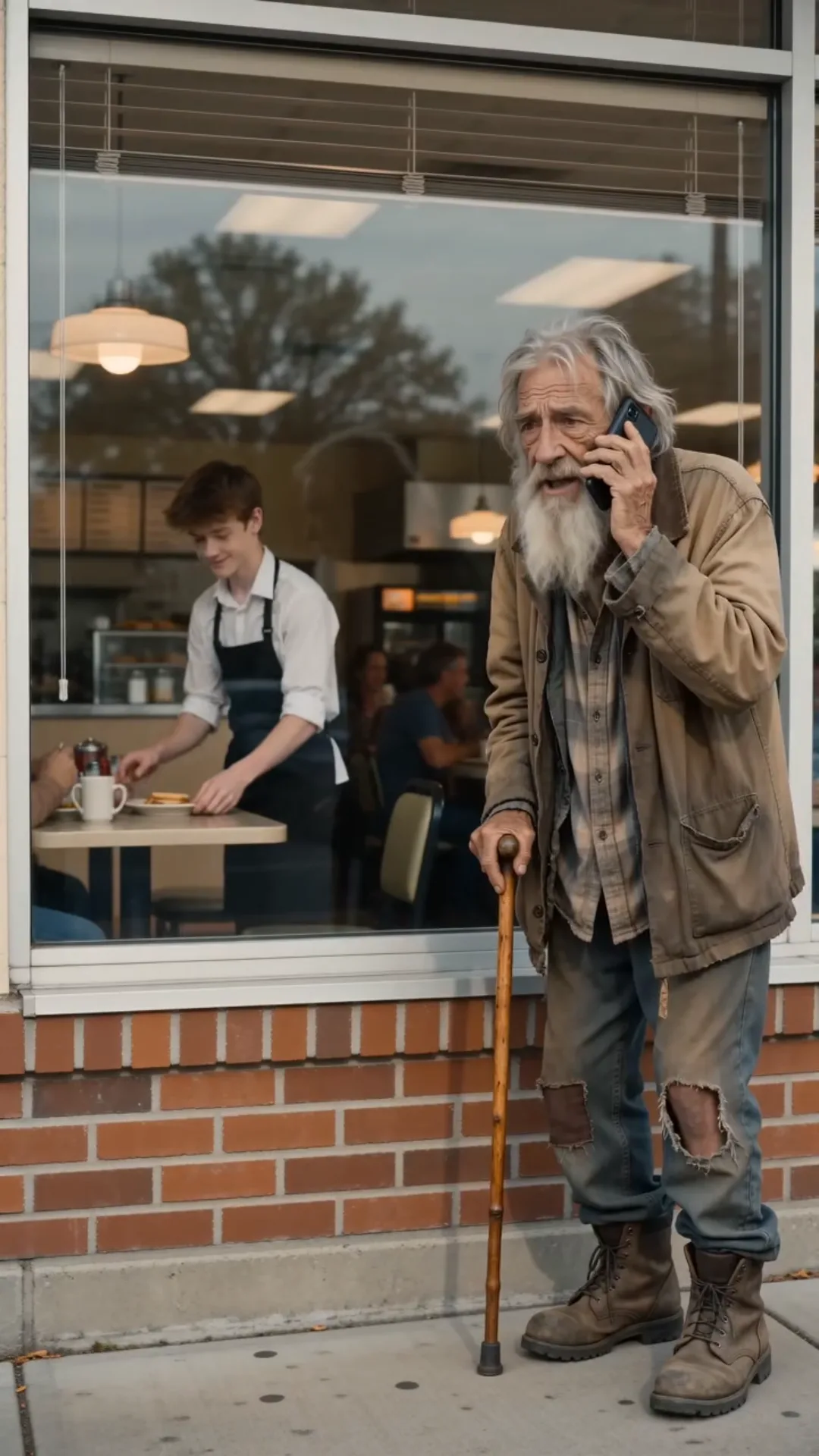
At 7:12 on a cold Tuesday morning, an old man walked into Miller’s Family Diner carrying everything he appeared to own.
A wooden cane.
A faded brown jacket.
A battered leather wallet.
And a secret that could change someone’s life.
No one inside the crowded diner knew that.
To the customers sipping coffee beneath the warm yellow lights, he was simply another tired old man who had probably wandered in from the bus station three blocks away. His silver-gray hair looked as though it had not seen a comb in days. His long white beard was uneven and untrimmed. One knee of his trousers had been carefully patched with a square of darker cloth, and the soles of his old work boots were so worn that they bent when he walked.
Several customers glanced at him.
Most looked away.
A woman in a cream business suit pulled her handbag closer to her chair. Two construction workers paused their conversation for a second, then continued eating. A teenage boy at a corner booth whispered something to his friend and laughed.
The old man seemed not to notice.
He stood just inside the entrance, his hand resting on the curved handle of his cane, and quietly studied the room.
Nearly every table was occupied.
Waiters moved quickly between booths carrying coffee pots, pancakes, eggs, toast, bacon and steaming plates of hash browns. Silverware clattered against ceramic dishes. The coffee machine hissed behind the counter. Morning sunlight poured through the large front windows, illuminating tiny particles of dust above the tables.
It was the busiest hour of the day.
And it was exactly when eighteen-year-old Noah Parker usually forgot that his feet hurt.
“Table seven needs coffee!”
“I’ve got it!”
“Two orange juices for twelve!”
“Coming!”
Noah moved between the tables with the nervous efficiency of someone who had been doing the job long enough to know every shortcut but not long enough to stop caring.
His white shirt was already slightly wrinkled at the elbows. His black apron carried a tiny stain from maple syrup. His brown hair refused to stay neatly combed no matter how often he pushed it back.
He was young enough that some customers still called him “kid.”
But Noah had been helping pay his family’s bills for almost two years.
His mother, Rachel, worked nights cleaning offices downtown. His younger sister, Lily, was thirteen and needed braces they could not yet afford. Their father had died four years earlier after a sudden heart attack, leaving behind a small life insurance payment that disappeared beneath medical bills, rent and everyday expenses faster than anyone expected.
Noah had once dreamed about college.
He still kept the acceptance letter from Northwood State University folded inside the top drawer of his bedroom desk.
He had been accepted into its hospitality management program.
He had also been offered a partial scholarship.
Partial was the problem.
Tuition, books, transportation, meals and everything else remained more than his family could manage.
So while his former classmates uploaded photographs from college campuses and dorm rooms, Noah worked six days a week at Miller’s.
He told everyone he was taking “a year off.”
Only his mother knew that he had already decided not to go.
The diner’s manager, Frank Donnelly, noticed the old man standing at the entrance.
Frank was fifty, broad-shouldered, clean-shaven and permanently impatient. He wore a white shirt, black tie and an expression suggesting that every second cost money.
He leaned toward Noah.
“Your customer.”
Noah looked toward the door.
“Mine?”
“Everyone else is full.”
Frank lowered his voice.
“And keep an eye on him.”
Noah frowned slightly.
“What do you mean?”
Frank glanced at the old man’s worn clothes.
“You know exactly what I mean.”
Noah did know.
He simply didn’t like it.
He walked toward the entrance.
“Good morning, sir.”
The old man looked up.
His eyes surprised Noah.
They were tired, certainly, but unusually sharp.
Observant.
Calm.
“Good morning,” the man replied.
“Just one today?”
“Yes.”
Noah picked up a menu.
“Right this way.”
There was a tiny booth near the large front window that had just become available. Noah cleared the empty coffee cups, wiped the table and motioned for the man to sit.
“My name’s Noah. I’ll take care of you.”
The old man eased himself slowly into the booth.
“Samuel.”
“Nice to meet you, Samuel.”
Noah placed the menu on the table.
“Coffee?”
Samuel hesitated.
“How much is it?”
“Two fifty.”
Samuel’s fingers brushed the outside of his jacket as though checking something in his pocket.
Then he nodded.
“One coffee, please.”
Noah started to leave, then stopped.
“Refills are free.”
For the first time, Samuel smiled.
“Then perhaps today is already improving.”
A few minutes later, Noah returned with coffee.
Samuel held the warm mug between both hands for several seconds before drinking.
When Noah came back to take his order, Samuel studied the menu carefully.
“What’s your least expensive breakfast?”
Noah knew the prices without looking.
“Toast is three dollars. Oatmeal is four twenty-five. Two eggs and toast is six fifty.”
Samuel nodded.
“Oatmeal, then.”
Noah looked at him.
“Hungry?”
Samuel smiled faintly.
“A little.”
“How hungry?”
The old man seemed amused by the question.
“Enough that the pictures on this menu are becoming emotionally complicated.”
Noah laughed.
“I’ll tell you what. We have a breakfast special. Eggs, toast, potatoes and two pancakes.”
Samuel immediately shook his head.
“No, no. That would be too much.”
“It’s the special.”
“How much?”
Noah paused.
“Same as the oatmeal today.”
That was not true.
The breakfast special was $9.95.
But Samuel did not know that.
He slowly closed the menu.
“In that case… the special sounds wonderful.”
“You got it.”
As Noah walked toward the kitchen, Frank intercepted him.
“What did he order?”
“Breakfast special.”
Frank glanced toward the old man.
“He paying?”
“I assume so.”
“You assume?”
Noah lowered his voice.
“Frank, he’s an old man ordering breakfast, not robbing a bank.”
“I run a business.”
“And I’m doing my job.”
Frank stared at him for a moment.
Then he pointed toward the kitchen.
“Table eleven is waiting.”
Noah walked away before his irritation became visible.
Ten minutes later he carried Samuel’s breakfast to the table.
Eggs.
Potatoes.
Toast.
Two pancakes.
Samuel stared at the plate.
Something changed in his expression.
For one brief moment, the old man looked almost overwhelmed.
“This is the oatmeal?”
Noah smiled.
“Chef got confused.”
Samuel looked directly at him.
They both knew there had been no confusion.
“Thank you.”
“No problem.”
Samuel ate slowly.
Not like a man enjoying breakfast.
Like a man respecting it.
He cut his pancakes into small pieces. He wiped the last bit of egg from the plate with his toast. He drank three cups of coffee and thanked Noah every single time his cup was refilled.
Occasionally, Samuel watched the young waiter moving around the diner.
Noah carried groceries from the delivery entrance for the cook without being asked.
He brought crayons to a restless little girl.
He replaced an elderly woman’s toast because it was colder than she liked.
When a businessman accidentally knocked a glass of orange juice onto the floor, Noah helped clean it without blaming him.
None of those things were extraordinary.
That was exactly what made them extraordinary.
No one was watching Noah.
At least, Noah believed no one was.
At 8:03, Samuel finished his breakfast.
Noah approached with the bill.
“Whenever you’re ready.”
Samuel looked at the small paper slip.
$9.95.
For the first time that morning, real worry appeared on his face.
He reached into his jacket and pulled out an old brown leather wallet.
The leather was cracked around the edges.
Samuel opened it.
His expression went still.
He checked one compartment.
Then another.
Then a small side pocket.
Nothing.
No cash.
No card.
He searched his jacket.
One pocket.
Another.
His movements became more desperate.
Several nearby customers noticed.
Frank noticed too.
Samuel’s hand slowly stopped.
His shoulders fell.
Noah understood immediately.
Samuel stared down at the empty wallet.
His voice was almost too quiet to hear.
“I’m sorry.”
Noah waited.
Samuel swallowed.
“I don’t have enough.”
The conversations around them became noticeably quieter.
A man at the next table looked over.
The woman in the cream business suit raised an eyebrow.
Samuel’s face reddened beneath his weathered skin.
“I thought I had money in here.”
He looked into the wallet again, as though ten dollars might somehow appear if he searched carefully enough.
“It seems I was mistaken.”
Frank began walking toward the table.
Noah saw him coming.
Samuel did too.
The old man slowly started to stand.
“I can leave my cane. I’ll come back when—”
“No.”
Noah reached into his apron.
He pulled out the small bundle of tips he had earned that morning.
Three one-dollar bills.
A five.
Several more singles.
And the twenty-dollar bill a family had left him thirty minutes earlier.
He placed ten dollars beside the receipt.
Samuel stared at the money.
Then at Noah.
Noah picked up the bill.
“Breakfast is on me.”
The old man said nothing.
For several seconds, his eyes remained fixed on Noah’s face.
Behind them, Frank stopped walking.
“You paid for him?”
Noah turned.
“Yes.”
“With your tips?”
“Yes.”
Frank shook his head.
“Noah, you can’t pay every time someone walks in here without money.”
Noah glanced at Samuel.
Then he looked back at his manager.
“I’m not paying for everyone.”
“Then why him?”
Noah’s answer came without hesitation.
“Because no one should leave hungry.”
The diner fell strangely quiet.
Not completely silent.
The coffee machine still hissed.
Dishes still clinked inside the kitchen.
But the people close enough to hear stopped talking.
Samuel slowly stood.
For a moment Noah thought he saw tears in the old man’s eyes.
Instead, Samuel simply held out his hand.
Noah shook it.
Samuel’s grip was stronger than expected.
“Thank you, Noah Parker.”
Noah blinked.
He did not remember telling the old man his last name.
Before he could ask about it, Samuel turned toward the door.
His cane tapped softly against the tiled floor.
Once.
Twice.
Three times.
He was almost outside when he stopped.
Then he turned around.
And reached inside his worn brown jacket.
PART 2 — THE SILVER LIGHTHOUSE
Every eye near the front of the diner followed Samuel’s hand.
Frank took one cautious step forward.
Noah remained beside the empty booth.
Samuel removed a small leather case.
It was old and weathered, almost as worn as his wallet. It could have been a coin pouch, a photograph case or something passed between generations.
He walked back toward Noah.
The diner seemed quieter with every step.
Samuel opened the case.
Inside was a polished silver badge.
At its center was a lighthouse rising above engraved ocean waves.
Around the outer edge were five words:
CHARACTER BEFORE STATUS. SERVICE BEFORE SELF.
Noah stared at it.
He had never seen the symbol before.
Samuel removed the badge and placed it gently into Noah’s hand.
It was heavier than it looked.
Cold.
Solid.
Real.
“What is this?” Noah asked.
Samuel’s voice remained calm.
“Something you cannot buy.”
Frank moved closer.
“Sir, I’m going to need you to explain what’s happening.”
Samuel looked at him.
“In time.”
Then he returned his attention to Noah.
“People see your kindness.”
He closed Noah’s fingers around the badge.
“So do we.”
Noah looked down at the lighthouse.
“We?”
But Samuel was already walking away.
He opened the diner door.
A small brass bell rang above it.
Then the old man stepped into the morning sunlight and disappeared down the sidewalk.
For the next several seconds, no one said anything.
Then voices erupted.
“What was that?”
“Some kind of organization?”
“Is that real silver?”
“Maybe he was testing the kid.”
Frank reached toward the badge.
“Let me see that.”
Noah pulled his hand back.
Samuel had given it to him.
Something instinctively told him not to let anyone else take it.
Frank frowned.
“You don’t know where that came from.”
“Neither do you.”
“It could be some scam.”
“What scam? He gave me a badge and left.”
One of the construction workers took out his phone.
“Beacon Society,” he muttered. “That’s the symbol. I’ve seen it somewhere.”
The woman in the cream suit looked over sharply.
“What did you say?”
“The Beacon Society.”
She stood and approached.
“May I see that?”
Noah hesitated, then opened his palm.
The woman’s confident expression changed instantly.
“Where did you get this?”
“The old man.”
She stared toward the window.
“He was with the Beacon Society?”
“What is it?”
The woman looked at Noah as though the answer should have been obvious.
“They fund scholarships. Hospitals. Housing projects. Small businesses. Disaster relief.”
The construction worker was scrolling rapidly.
“Yeah. It says they’re a private philanthropic foundation.”
His friend leaned closer.
“How private?”
“Very.”
He kept scrolling.
“Apparently they don’t advertise most of what they do.”
Noah looked down at the badge.
Frank’s expression tightened.
“Give me that phone.”
The worker turned the screen.
The Beacon Society had been founded nearly seventy years earlier by a group of industrialists, teachers, doctors and veterans who believed traditional charity often solved immediate problems without changing the systems beneath them.
Their work was deliberately quiet.
No galas.
No celebrity endorsements.
No giant checks held in front of cameras.
They financed community businesses, education, medical programs and local leadership initiatives.
And according to one article, they had an unusual method for selecting some scholarship recipients and future fellows.
They watched people when those people believed no one important was watching.
Frank slowly looked toward Noah.
“You knew who he was.”
Noah laughed in disbelief.
“What?”
“You knew.”
“I thought he couldn’t pay for breakfast.”
“You expect me to believe some billionaire foundation sends a representative in here and you randomly buy his food?”
“I don’t even know what the Beacon Society is.”
Frank folded his arms.
“This better not bring trouble into my restaurant.”
That sentence landed strangely.
My restaurant.
Noah had worked there since he was sixteen.
He had covered double shifts when employees quit. He had cleaned bathrooms after closing. He had skipped birthdays, football games and family dinners.
Yet in Frank’s mind it was still only his restaurant.
Noah belonged to it only while he was useful.
Noah slipped the badge into his pocket.
“I need to get back to work.”
For the rest of the morning, nothing happened.
That almost made the encounter feel unreal.
Customers finished breakfast.
Tables emptied.
The rush faded.
Noah refilled ketchup bottles and stacked clean glasses.
At 10:45, he checked his phone during a break.
No new messages.
At 11:20, he carried trash to the dumpster.
Nothing.
By noon he began wondering if the Beacon Society story was exaggerated.
Maybe Samuel was simply an eccentric old man who carried a badge.
Maybe the entire thing meant nothing.
At 12:43, a black sedan stopped outside the diner.
Frank noticed it first.
Two people stepped out.
A woman in her early forties wearing a navy suit.
A tall man carrying a leather portfolio.
They entered the diner.
The woman scanned the room.
“Is Noah Parker here?”
Every employee turned.
Noah slowly raised his hand.
“That’s me.”
The woman smiled.
“My name is Evelyn Shaw. Beacon Society.”
Frank immediately approached.
“I’m the manager.”
Evelyn politely shook his hand.
“Good afternoon.”
“If this is about the situation this morning, I want to make it clear that the diner did not authorize—”
“This is not about the diner.”
Her eyes returned to Noah.
“It’s about him.”
Frank stopped speaking.
Evelyn handed Noah an envelope.
Thick cream paper.
His full name was written across the front.
“Noah, Mr. Reed would like to invite you to an interview this afternoon.”
Noah stared at her.
“Mr. Reed?”
“The man you served breakfast.”
“I’m working until four.”
Frank spoke quickly.
“He can’t leave in the middle of his shift.”
Evelyn nodded.
“Of course.”
She looked at Noah.
“We can wait.”
Frank’s face changed.
“You’ll wait four hours?”
“If necessary.”
Noah stared at her.
“Why?”
Evelyn smiled faintly.
“Because Mr. Reed waited three months.”
Noah felt a chill.
“For what?”
“For someone like you.”
At four o’clock exactly, Noah removed his apron.
Evelyn and the tall man were still sitting in booth six.
Samuel’s booth.
Frank called Noah into the office before he could leave.
“You should be careful.”
“About what?”
“These foundations. Wealthy people. They make promises. Sometimes there are conditions.”
Noah almost smiled.
“You think the man who couldn’t afford breakfast is going to trick me?”
“I think you don’t know who he is.”
“That makes two of us.”
Frank leaned back.
“You’re scheduled tomorrow at six.”
“I know.”
“Don’t come in thinking some charity is going to make you rich.”
Noah looked at the manager who had spent the morning suspicious of a hungry old man.
“I’m not.”
Then he left.
The sedan drove downtown.
Noah expected a skyscraper.
Instead, Evelyn took him to an old brick building near the river.
The sign outside read:
BEACON COMMUNITY CENTER
Children played basketball in a gym.
An elderly woman attended a computer class.
Two men in work clothes met with a financial counselor.
A young mother spoke with a nurse.
Noah looked around.
“This is the Beacon Society?”
“One part of it,” Evelyn said.
She led him upstairs.
At the end of a hallway was a simple conference room.
No marble.
No luxury.
No giant portraits.
Only a wooden table, six chairs and a window overlooking the city.
Samuel Reed stood beside it.
The torn jacket was gone.
So were the patched trousers.
Samuel now wore a simple charcoal suit.
His beard remained long.
His hair remained messy.
But suddenly the poor old man from the diner looked entirely different.
Not because of his clothes.
Because Noah was finally seeing the authority that had been there all along.
“Sit down, Noah.”
Noah did.
Samuel placed the battered leather wallet on the table between them.
It was the same wallet.
“You were testing me.”
Samuel nodded.
“Yes.”
Noah felt something he had not expected.
Anger.
“So none of it was real?”
Samuel studied him.
“What part?”
“The empty wallet. The clothes. The whole thing.”
“The clothes were chosen for the test.”
Samuel pushed the wallet toward him.
“The wallet is mine.”
“And the money?”
Samuel opened it.
Empty.
“I intentionally carried none.”
Noah stood.
“That’s manipulation.”
Evelyn shifted slightly.
Samuel raised one hand.
“No. Let him speak.”
Noah looked directly at the old man.
“You made people think you were poor so you could see how they treated you.”
“Yes.”
“That’s not fair.”
“No.”
Samuel’s answer surprised him.
“It isn’t.”
Noah frowned.
Samuel continued.
“Life is not fair either. People with power often evaluate people without telling them. Employers do it. Teachers do it. Customers do it. Society does it every day.”
He leaned forward.
“The difference is that most people test whether someone is useful to them.”
His eyes held Noah’s.
“We test whether someone is kind when there is nothing to gain.”
Noah slowly sat again.
Samuel opened a folder.
Inside was a photograph of Noah carrying groceries for an elderly customer outside the diner.
Another showed him fixing a homeless man’s broken backpack.
Another showed him giving his umbrella to a woman waiting at a bus stop.
Noah stared at them.
His stomach tightened.
“You’ve been following me?”
“We have been observing seventeen candidates in this city.”
“For what?”
Samuel closed the folder.
“For an opportunity.”
“What opportunity?”
Samuel took a slow breath.
“The Beacon Fellowship.”
Noah had no idea what that meant.
Samuel explained.
Every three years, the Beacon Society selected a small number of young people who demonstrated what the organization considered three rare qualities:
Ability.
Resilience.
Character.
The winners received full university tuition, living expenses, mentorship and paid work placements with Beacon-affiliated organizations.
Noah felt as though the room tilted.
“Full tuition?”
“Yes.”
“What college?”
“Any accredited university that accepts you.”
Noah stared at Samuel.
Northwood.
The folded acceptance letter in his bedroom drawer flashed through his mind.
Samuel continued.
“But there is more.”
Noah barely heard him.
“Our fellows are not chosen because they are poor. Or because they performed one nice act.”
He tapped the folder.
“They are chosen because of patterns.”
Samuel opened another page.
“You worked thirty-one hours during your senior year while maintaining a 3.7 GPA.”
Noah’s throat tightened.
“You turned down a promotion because it required taking shifts from another employee supporting two children.”
Noah looked at Evelyn.
“How do you know that?”
Samuel continued.
“When your father died, you stopped playing baseball and started working.”
Noah’s expression hardened.
“Don’t talk about my dad.”
Samuel stopped.
For a moment, his voice softened.
“I lost my father at seventeen.”
Noah said nothing.
“I know what it does to a family.”
Samuel closed the file.
“And I know what it does to a young man who decides everyone else’s future matters more than his own.”
Silence filled the room.
Then Samuel slid one final document across the table.
At the top were the words:
FINAL CANDIDATE EVALUATION
Noah looked up.
“You said I passed the first test.”
“Yes.”
“How many are there?”
Samuel’s expression changed.
“Three.”
Noah swallowed.
“What’s the second?”
Samuel stood.
“That begins tomorrow.”
PART 3 — THE TEST THAT COST EVERYTHING
The second test did not look like a test.
That was the point.
At nine the following morning, Noah received an address from Evelyn.
A Beacon-operated food distribution center on the south side.
He had already asked Frank for the morning off.
Frank refused.
So Noah traded shifts with another waiter and agreed to work until midnight later that week.
When he arrived at the center, Samuel was nowhere to be seen.
Instead, Evelyn introduced him to six other young people.
All final candidates.
There was Maya, a nursing student.
Carlos, an apprentice electrician.
Jenny, a community college student working two jobs.
Marcus, a former high school athlete.
Aiden, whose father owned three car dealerships.
And Tessa, a brilliant economics student.
Noah immediately felt out of place.
The others seemed prepared.
Some had résumés.
Folders.
Recommendations.
Noah had brought nothing.
Evelyn smiled at the group.
“Today, you’ll spend six hours here.”
“What are we being evaluated on?” Tessa asked.
Evelyn glanced around.
“Work.”
That was all.
The candidates were divided among different tasks.
Sorting food.
Loading boxes.
Checking expiration dates.
Helping families carry groceries to cars.
No speeches.
No interviews.
For several hours, the work was ordinary.
Then everything went wrong.
A delivery truck arrived two hours late.
One volunteer went home sick.
A refrigeration unit failed.
A line formed outside the building.
Families began waiting.
People grew frustrated.
The coordinator, Maria, received a phone call and suddenly rushed away because her child had been injured at school.
For the first time, there was no obvious person in charge.
Tessa immediately started giving instructions.
Aiden complained that the program was poorly organized.
Marcus continued packing boxes.
Maya helped an elderly woman who became dizzy.
Noah looked at the line.
Then the boxes.
Then the loading area.
He did what he had spent two years doing at the diner during breakfast rush.
He organized chaos.
“You two keep packing,” he told Marcus and Carlos.
He asked Jenny to begin writing family names and household sizes on paper because the computer system had frozen.
He asked Aiden to move bottled water closer to the entrance.
Aiden frowned.
“Who put you in charge?”
“No one.”
“Then stop acting like it.”
Noah looked at the line outside.
“Fine. Don’t help.”
Then he lifted two cases of water himself.
Three minutes later, Aiden quietly grabbed the other side.
Within half an hour, the line was moving.
Not perfectly.
But moving.
Then a mother approached.
She had three children.
Her youngest boy wore a red sweater and held a toy dinosaur.
Jenny checked the list.
“I’m sorry. Your household already collected this week.”
The woman looked embarrassed.
“My sister picked it up. She lives with us, but she took most of it to her boyfriend’s apartment.”
Jenny shook her head.
“The rule says once per household.”
The woman’s eyes filled.
“I understand.”
She took her children’s hands.
“We’ll figure something out.”
Noah looked toward the shelves.
There were still boxes.
He looked at the line.
Then the rules posted on the wall.
One household.
One distribution.
No exceptions without coordinator approval.
The coordinator was gone.
If he gave the woman food, he would violate policy during an evaluation.
The safe choice was obvious.
Follow the rule.
Noah picked up a box.
“Ma’am.”
The woman turned.
He handed it to her.
Jenny whispered, “We’re not supposed to.”
“I know.”
“What if they’re watching?”
Noah looked at the little boy holding the dinosaur.
“Then they’re watching.”
By the end of six hours, Noah’s shirt was soaked with sweat.
His hands hurt.
He had forgotten that he was being evaluated.
Which was also the point.
Two days later, Samuel called him back to the community center.
Noah entered the same conference room.
This time, five people sat around the table.
Samuel.
Evelyn.
A doctor.
A business owner.
And a retired school principal.
Samuel began.
“You violated food distribution policy.”
Noah nodded.
“Yes.”
“You gave a box to a household that had already received its weekly allocation.”
“Yes.”
“Why?”
“The kids were hungry.”
“That’s not an answer to the policy question.”
“It’s my answer.”
The business owner leaned forward.
“What if everyone claimed the same thing?”
“Then you investigate.”
“You didn’t.”
“There wasn’t time.”
“So rules stop mattering when you feel emotional?”
Noah felt his face grow warm.
“No.”
“Then explain.”
Noah took a breath.
“Rules matter when they protect people. That rule exists so people don’t take advantage and leave nothing for others.”
The woman nodded.
“So?”
“There was enough food.”
“You didn’t know that.”
“I checked inventory before I gave her the box.”
For the first time, the panel exchanged glances.
Noah continued.
“If there had been ten boxes left and fifty families waiting, I wouldn’t have done it. But there were more than enough supplies for the remaining registered households.”
The retired principal asked, “Why didn’t you mention that earlier?”
“Because you asked why I gave it to her.”
“And?”
“Because her kids were hungry.”
Samuel smiled slightly.
Noah had passed the second test.
The third came one week later.
And this time, it hurt.
Frank called Noah into his office at the diner.
On the desk lay a printed article.
LOCAL WAITER CONSIDERED FOR ELITE BEACON FELLOWSHIP.
Someone had posted about the breakfast incident online.
The story had spread.
Customers had begun visiting the diner asking for Noah.
Some left large tips.
One customer tipped him two hundred dollars.
Frank was furious.
“You’re using this restaurant to promote yourself.”
Noah stared at him.
“I didn’t write the article.”
“You’re becoming a distraction.”
“I’m serving tables.”
“People are coming here because of you.”
“That sounds good for business.”
Frank’s jaw tightened.
Then he placed an envelope on the desk.
“We had seventeen complaints this month.”
“About me?”
“About service.”
“Were they my tables?”
“That’s irrelevant.”
Noah knew what was happening.
Frank was afraid.
If Noah won the fellowship, he would leave.
And if the story grew, people might ask uncomfortable questions about why a young waiter known publicly for kindness worked for a manager known privately for the opposite.
Frank pushed the envelope toward him.
“I’m reducing your hours.”
Noah stared at the schedule.
Fourteen hours.
He normally worked thirty-five.
“Frank, I need those hours.”
“I’m aware.”
“My family needs them.”
“Then perhaps you should focus on your job instead of this foundation circus.”
Noah’s hands tightened.
For the first time since he had started working at sixteen, he wanted to hit something.
Instead, he quietly folded the schedule.
“Okay.”
Frank seemed surprised.
“Okay?”
“Yes.”
“You have nothing else to say?”
Noah stood.
“No.”
He walked out.
That night, Noah sat at the kitchen table with his mother.
Bills were spread between them.
Rent.
Electricity.
Insurance.
Groceries.
His mother looked exhausted.
“You should stay in the fellowship process.”
“We need money.”
“We always need money.”
“I can pick up another job.”
“And when will you sleep?”
“I’ll figure it out.”
Rachel reached across the table and took his hand.
“Noah.”
He looked away.
“You’ve spent four years figuring things out for everyone else.”
Her voice trembled.
“When do you get to build your own life?”
He did not answer.
The next morning, Evelyn called.
“Noah, we need you at the Beacon Center tonight at six.”
“For what?”
“The final evaluation.”
He looked at his new reduced work schedule.
He had been given one of his few remaining shifts.
Six to eleven.
“I’m working.”
There was a pause.
“This evaluation cannot be rescheduled.”
Noah closed his eyes.
If he missed work, Frank might fire him.
If he missed the interview, the Beacon Fellowship disappeared.
“How long is it?”
“Approximately ninety minutes.”
“I’ll be there.”
At 5:40, Noah walked into Miller’s wearing his uniform.
Frank stared at him.
“You’re early.”
“I need to leave at five fifty.”
Frank laughed.
“No.”
“I told Melissa. She can cover.”
“You are scheduled.”
“I know.”
“If you leave, don’t come back.”
The words hung between them.
Noah looked around the diner.
For two years, this place had been security.
Not much.
But something.
He remembered bringing his first paycheck home.
His mother crying.
His sister hugging him.
He remembered telling himself that sacrifice was temporary.
Then he thought about the acceptance letter in his drawer.
Northwood.
A life he had stopped allowing himself to imagine.
“I have to go.”
Frank stepped closer.
“If you walk out that door, you’re fired.”
Noah slowly untied his apron.
He placed it on the counter.
“Then I’m sorry.”
Frank’s face changed.
“You think those people are going to rescue you?”
“No.”
Noah picked up his jacket.
“I think I have to stop waiting for permission to try.”
He left.
At 6:07, Noah ran into the Beacon Center.
Breathing hard.
“Sorry.”
Evelyn checked her watch.
“You’re seven minutes late.”
“I lost my job.”
Her expression changed.
“What?”
“My manager said if I left for this, I was fired.”
“And you left?”
“Yes.”
Samuel entered from the hallway.
“You sacrificed your job for the fellowship?”
Noah stared at him.
“No.”
Samuel raised an eyebrow.
“No?”
“I left because I realized I couldn’t stay somewhere that punished me for wanting something better.”
Samuel said nothing.
Noah continued.
“If I lose this fellowship tonight, I’ll find another job tomorrow.”
He took a breath.
“I’m done being afraid that one bad week can decide the rest of my life.”
Silence.
Then Samuel sat.
“The final test is simple.”
Noah sat across from him.
Samuel placed a folder on the table.
Inside was a financial statement.
The Beacon Society was offering Noah a one-year paid internship at one of its community centers.
Salary: $42,000.
It was more money than Noah had ever imagined earning at eighteen.
There was one condition.
Accepting the internship would remove him from consideration for the fellowship.
No college funding.
No full scholarship.
Immediate money instead.
Noah stared at the page.
Forty-two thousand dollars.
His mother could stop working nights.
Lily could get braces.
They could catch up on bills.
Maybe even save something.
Samuel spoke quietly.
“You have ten minutes.”
Noah felt angry again.
“This is the test?”
“Yes.”
“You’re making me choose between my family and college.”
“No.”
“That’s exactly what this is.”
Samuel remained calm.
“We are asking what you want.”
“I want both.”
“That is not one of the choices.”
Noah stood and walked toward the window.
Outside, the city lights had begun appearing.
He imagined his mother scrubbing office floors at two in the morning.
He imagined Lily covering her mouth when she smiled because classmates teased her teeth.
He imagined $42,000.
Then he imagined himself at twenty-five.
Thirty.
Forty.
Still making every decision because someone else needed something first.
Nine minutes passed.
Samuel said nothing.
Finally Noah returned to the table.
He pushed the financial offer away.
“I choose college.”
Samuel looked at him.
“Why?”
Noah’s voice shook.
“Because if I keep choosing the fastest way to solve every problem, I’ll spend my entire life putting out fires.”
He swallowed.
“I want to learn how to build something that doesn’t keep burning.”
Samuel leaned back.
“And your family?”
“I’ll work.”
“What if that’s difficult?”
“It will be.”
“What if you regret it?”
“I probably will sometimes.”
Samuel nodded.
Then he picked up the offer.
And tore it in half.
Noah stared at him.
Samuel smiled.
“The forty-two-thousand-dollar internship never existed.”
Noah’s face went pale.
“What?”
“The job exists.”
Samuel placed another paper on the table.
“But it does not disqualify you from the fellowship.”
Noah looked at the new document.
BEACON FELLOW — FULL SCHOLARSHIP
His name appeared beneath it.
NOAH PARKER.
For several seconds he could not speak.
Samuel stood.
“Congratulations.”
Noah looked at Evelyn.
Then at the panel.
Then back at Samuel.
“You already decided?”
“Yesterday.”
“Then what was tonight?”
Samuel’s expression softened.
“The final test was not whether you would choose college.”
He pointed to the torn paper.
“It was whether fear would choose for you.”
Noah’s eyes filled with tears.
Samuel extended his hand.
“Your tuition is covered for four years. Housing, books and meals included.”
Noah could barely breathe.
“And the internship?”
“Paid. Flexible around your classes.”
Noah covered his face.
For the first time in years, he cried without trying to hide it.
But Samuel was not finished.
“There is something else.”
PART 4 — THE LIGHTHOUSE
Three months later, Noah stood inside Miller’s Family Diner again.
But this time he was not wearing an apron.
He wore a dark blue jacket, clean white shirt and the silver lighthouse badge Samuel had given him pinned discreetly inside the jacket where only he knew it was there.
The diner looked almost exactly the same.
Morning sunlight.
Coffee.
Pancakes.
Families talking.
Dishes clinking.
But Frank was gone.
Two weeks after firing Noah, the diner’s owner had discovered multiple complaints from employees about withheld tips, unfair scheduling and intimidation.
Frank was dismissed.
A new manager had taken over.
When Noah walked inside, Melissa—the waitress who had offered to cover his final shift—ran from behind the counter and hugged him.
“College boy!”
Noah laughed.
“Not yet.”
“Three days!”
Northwood State University began orientation that Friday.
His tuition was fully paid.
His housing was covered.
His books had arrived the week before.
His mother had cried when the first official scholarship letter came.
Then she cried again when Samuel visited their apartment.
Because the Beacon Society’s help had not ended with Noah.
Samuel explained something important that evening.
“We do not reward kindness by making someone responsible for saving everyone.”
Through one of its partner programs, Rachel was offered training for a full-time administrative position at a medical clinic.
Better hours.
Better pay.
Health insurance.
She accepted.
Lily got her braces through a local dental initiative funded by the Society.
But Samuel insisted Noah understand one thing.
None of those things were payment for breakfast.
“Kindness is not a transaction,” he told him.
“If I gave you wealth because you bought me eggs, then what you did would become an investment.”
Instead, the Society opened doors.
The Parkers still had to walk through them.
Rachel studied for her certification every evening.
Lily endured painful orthodontic appointments.
Noah prepared for college.
Nothing magical happened.
But for the first time in years, effort had somewhere to go.
Noah sat down in the same booth where Samuel had eaten breakfast months earlier.
Melissa brought coffee.
“On the house.”
Noah smiled.
“I can afford coffee now.”
“Don’t ruin this for me.”
She walked away.
A minute later, the brass bell over the entrance rang.
Samuel entered.
He was wearing the old faded brown jacket.
The same patched trousers.
The same worn boots.
And he carried the same wooden cane.
Noah laughed when he saw him.
“You’ve got to be kidding.”
Samuel sat across from him.
“It’s comfortable.”
“You own at least one suit.”
“Unfortunately.”
Noah pushed a coffee toward him.
Samuel looked around the diner.
“Do you remember that morning?”
“Every second.”
“Good.”
“Why?”
Samuel reached into his jacket.
For a second, Noah expected the leather case.
Instead, Samuel removed an old black-and-white photograph.
He placed it on the table.
The photograph showed a diner in 1967.
A young man stood behind a counter wearing an apron.
Across from him sat an exhausted teenager in dirty work clothes.
Noah leaned closer.
“Who are they?”
Samuel pointed to the teenager.
“Me.”
Noah looked at him.
“You?”
Samuel nodded.
“I was seventeen.”
He pointed to the waiter.
“His name was Thomas Bell.”
Samuel leaned back.
“My father died when I was sixteen. My mother became ill shortly afterward. I left school and worked wherever anyone would hire me.”
He tapped the photograph.
“One winter morning, I had not eaten in almost two days.”
Noah listened silently.
“I walked into that diner with thirty-seven cents.”
Samuel smiled.
“I ordered coffee because I thought it was the cheapest thing on the menu.”
“What happened?”
“Thomas brought me eggs, potatoes and toast.”
Noah looked at the photograph.
“Did he know you couldn’t pay?”
“Yes.”
Samuel’s eyes became distant.
“The owner yelled at him.”
“What did Thomas do?”
“He paid.”
Noah looked toward the kitchen.
The similarity was impossible to miss.
Samuel continued.
“After breakfast, Thomas asked what I wanted to do with my life.”
“What did you say?”
“I told him I wanted to build things.”
Samuel smiled faintly.
“He gave me the address of a construction company owned by his brother.”
Noah slowly understood.
“You got a job.”
“I did.”
Samuel looked down at his hands.
“That job became an apprenticeship. The apprenticeship led to night school. Night school led to engineering.”
“And eventually the Beacon Society?”
“Eventually.”
Noah stared at the photograph.
“Did Thomas know what happened to you?”
“Yes.”
“Did you stay in touch?”
“For forty-one years.”
“What happened to him?”
Samuel looked toward the front window.
“He died fifteen years ago.”
The noise of the diner seemed to fade.
Samuel touched the old photograph.
“Thomas never became wealthy.”
He smiled.
“He became a teacher.”
“A teacher?”
“He taught high school for thirty-eight years.”
Samuel looked at Noah.
“At his funeral, more than four hundred former students came.”
Noah swallowed.
Samuel slipped the picture back into his pocket.
“That was the day I realized something I should have understood long before.”
“What?”
Samuel looked around at the ordinary people eating ordinary breakfasts.
“The most important opportunities in life are often given by people who never see how far their kindness travels.”
Noah remained silent.
Samuel reached inside his jacket again.
This time he removed the weathered leather case.
The lighthouse badge was inside.
Not Noah’s badge.
Another one.
“Why a lighthouse?” Noah asked.
Samuel smiled.
“A lighthouse does not rescue ships.”
Noah waited.
“It simply makes sure they can see where the rocks are.”
Samuel closed the case.
“That is what the Beacon Society is supposed to do.”
Then he looked directly at Noah.
“And eventually, that is what we expect you to do.”
Noah laughed nervously.
“I’m eighteen.”
“So?”
“I haven’t even started college.”
“Then you have plenty of time to become disappointing.”
Noah laughed harder.
Samuel smiled.
For the next four years, Noah studied hospitality management and social enterprise at Northwood.
He was not the smartest student in every class.
He failed his first statistics exam.
He burned an entire tray of bread during a culinary management lab.
He once slept through an economics lecture after working until two in the morning on a Beacon project.
But he stayed.
During his second year, he began studying food waste.
Restaurants across the city threw away enormous amounts of safe, untouched food every night.
At the same time, local shelters struggled to serve enough meals.
The contradiction bothered him.
So Noah built a small program.
He called it Second Table.
Restaurants registered their unsold food through a simple digital platform. Volunteers collected it safely at closing. Community kitchens redistributed it the same evening.
The first week, three restaurants participated.
They provided seventy-two meals.
By the end of the semester, twelve restaurants participated.
Then thirty.
Then sixty-four.
The Beacon Society helped with refrigerated vans and legal support.
But Samuel refused to run the project for him.
“You started the fire,” Samuel said.
“You carry the wood.”
By graduation, Second Table had distributed more than 400,000 meals.
Noah graduated with honors.
Rachel sat in the front row.
Lily, now seventeen, screamed so loudly when his name was announced that three people turned around.
Samuel sat beside them.
He did not clap immediately.
He simply watched Noah cross the stage.
His eyes were wet.
Afterward, Noah found him near a tree outside the auditorium.
“You okay?”
Samuel cleared his throat.
“Allergies.”
“In November?”
“Very aggressive pollen.”
Noah smiled.
Samuel handed him an envelope.
Inside was a photograph.
It showed an eighteen-year-old Noah standing in Miller’s Diner.
White shirt.
Black apron.
Messy hair.
Holding a silver lighthouse badge.
Noah turned the photograph over.
Samuel had written:
Never forget the person you were when you believed no one important was watching.
Noah read it twice.
“Thank you.”
Samuel shook his head.
“No.”
He placed one hand on Noah’s shoulder.
“Thank the boy who paid for breakfast.”
Years passed.
Second Table expanded into fourteen cities.
Noah never became famous.
He was interviewed occasionally.
He appeared in local newspapers.
Once, a national television program invited him to tell the story of Samuel’s test.
He declined.
When asked why, Noah gave the same answer every time.
“The story isn’t about the man with the badge.”
It was about what people did before they knew the badge existed.
At twenty-nine, Noah became director of community initiatives for the Beacon Society.
At thirty-three, he returned to his hometown and opened a training restaurant for teenagers from low-income families.
The restaurant was called The Lighthouse Kitchen.
Students worked part-time while completing school.
They learned cooking, accounting, customer service and management.
Every employee received a meal during every shift.
No questions.
No deductions from pay.
No exceptions.
Samuel visited on opening day.
He was eighty-nine by then.
His beard had become almost completely white.
He still carried the same wooden cane.
And despite Noah’s complaints, he still occasionally wore the faded brown jacket.
They sat by the window.
Samuel ordered pancakes.
When the bill arrived, he reached for his old leather wallet.
Noah immediately pointed at him.
“Don’t.”
Samuel looked innocent.
“What?”
“If that wallet is empty, I’m calling security.”
Samuel laughed until he started coughing.
Noah paid anyway.
“Breakfast is on me.”
Samuel looked at him.
For a second, they were back in Miller’s Diner.
Eighteen and seventy-six.
Waiter and stranger.
Neither one fully understanding what had begun.
Samuel lifted his coffee.
“To breakfast.”
Noah lifted his own.
“To empty wallets.”
Three years later, Samuel Reed died peacefully in his sleep.
At his funeral, the church could not hold everyone.
Teachers came.
Doctors.
Construction workers.
Students.
Parents.
Business owners.
People who had received scholarships.
People whose businesses had survived because of Beacon loans.
People whose children had eaten because a community center remained open during difficult winters.
Noah sat in the front row.
In his pocket was the silver lighthouse badge.
Samuel left no mansion.
No luxury cars.
No private jet.
Most of his wealth had already been transferred into trusts supporting the Beacon Society for generations.
But he left Noah one personal item.
The battered leather wallet.
Inside it was a single folded piece of paper.
No money.
No credit cards.
Just a handwritten note.
Noah opened it after the funeral.
Dear Noah,
Most people spend their lives hoping to meet someone who can change their future.
They rarely realize that every day gives them the chance to become that person for someone else.
Thomas did it for me.
You did it for a hungry old stranger.
Now keep the light on.
— Samuel
Noah sat alone for a long time.
Then he folded the note carefully and returned it to the empty wallet.
Twenty-two years after that first breakfast, Noah walked into The Lighthouse Kitchen before opening time.
He was forty now.
There were faint lines beside his eyes.
A few gray hairs had appeared near his temples.
A seventeen-year-old trainee named Ethan was preparing tables.
Ethan lived with his grandmother.
His grades were good.
Money was not.
College seemed impossible.
Noah knew all of this.
But Ethan did not know Noah knew.
At 7:05, the front door opened.
An elderly woman entered wearing an old winter coat.
She sat alone near the window.
Ethan approached.
“Good morning, ma’am.”
She ordered oatmeal.
Twenty minutes later, she finished.
Ethan brought the bill.
The woman reached into her coat.
Checked one pocket.
Then another.
Her face changed.
“I’m terribly sorry.”
From the kitchen doorway, Noah watched.
The woman lowered her voice.
“I seem to have forgotten my purse.”
Ethan looked toward the manager.
Then at the woman.
Then at the bill.
He reached into his own pocket.
Noah almost smiled.
But Ethan stopped.
Instead of paying immediately, he sat across from the woman.
“Are you still hungry?”
The woman looked confused.
“A little.”
Ethan picked up the menu.
“Then I think you need pancakes too.”
The woman laughed.
“Young man, I cannot pay for the oatmeal.”
“I know.”
He stood.
“Pancakes are still a good idea.”
From the doorway, Noah felt his throat tighten.
He reached into his jacket.
His fingers touched a small weathered leather case.
Inside was a polished silver badge.
A lighthouse above the waves.
He did not take it out.
Not yet.
There was no need to rush.
Kindness deserved time before reward entered the room.
Noah looked toward the large windows.
Morning sunlight filled the restaurant.
Coffee poured.
Dishes clinked.
People talked quietly.
A hungry stranger sat at a table.
A young waiter chose compassion.
And somewhere inside an old empty wallet was a note from a man who had understood what Noah finally understood too.
Great lives did not always change because of enormous decisions.
Sometimes they changed because someone noticed hunger.
Because someone paid ten dollars.
Because someone offered a job.
Because someone opened a door.
Because someone believed that dignity mattered even when there was nothing to gain.
Noah watched Ethan place a plate of pancakes in front of the elderly woman.